What could a 19th century Norwegian man have to say about the life of a married Bengali woman during the British Raj?
It turns out that playwright Henrik Ibsen's universal themes questioning the traditional roles of men and women provide the opportunity for examining not only gender politics but British colonialism too.
Modern day British-Asian playwright Tanika Gupta's adaptation of Ibsen's 'A Doll's House' is a triumph. Together with the Lyric Theatre's new Artistic Director, Rachel O'Riordan, they re-locate Ibsen's play from a 1879 Norwegian town to Calcutta in the same year, then the capital of the British India.
Ibsen's Nora (wife of Torvald, mother of three, living out the ideal of the 19th-century wife) becomes Niru, a chirpy, husband-pleasing young Bengali wife married to English bureaucrat Tom. The play sees the unravelling of their lives leading Niru to question her situation and her own identity.
The whole cast shines - with Niru played by the dazzling actor Anjana Vasan who has many theatre, television and film credits (from Brexit: The Uncivil War (Channel 4) to Black Mirror (Netflix) and Disney's Cinderella too) and the towering Elliot Cowan as Tom also has a long list of previews credits including the current top BBC hit Peaky Blinders.
The stunning single-scene new setting is the internal courtyard of an Indian town house, complete with tree sprouting up through it's centre. It gave the sense of Niru's claustrophobic and enveloping world, trapped in her own doll's house. It was beautifully lit with the various doors off the courtyard providing useful entry and exit points.
The award-winning multi-instrumentalist composer was Arun Ghosh, who himself hovered above the action on a mezzanine verandah surrounded by the instruments which he delicately played, creating a tense backdrop at apt moments in the psychodrama.
Gupta chose to stick mostly to Ibsen's original script, making only a few alterations for the adaption. It's seems astonishing that in 1879 Ibsen portrayed such scandalous-for-the-time feminist sentiments.
In 2006, the centenary of Ibsen's death, A Doll's House held the distinction of being the world's most performed play that year showing - perhaps sadly, and inevitably - the enduring nature of the play's themes.
The Lyric provide a very useful 'education pack' (pdf) about the play and its adaptation.
A Doll's House, a new adaptation by Tanika Gupta, at the Lyric Theatre, London W6 0QL.
Showing posts with label migration. Show all posts
Tuesday, 1 October 2019
Tuesday, 15 November 2016
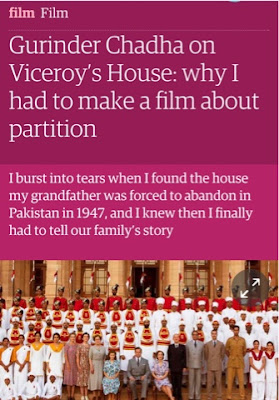
Viceroy's House: film about India-Pakistan 1947 partition
Really looking forward to 'Bend It Like Beckham' director Gurinder Chadha's next film, Viceroy's House, due out next year. It certainly has a cracking cast in Hugh Bonneville, Gillian Anderson, Simon Callow, Om Puri and Huma Qureshi :
Gurinder Chadha's films are always a treat especially to second-gen onwards Brit-Asians such as myself though they certainly have a wider appeal. I also happen to hail from the director's same West London suburb and from a Sikh-Punjabi background so her material particularly resonates with me and it's always interesting to see what she's homing in on. Every Punjabi family has a partition story - I'm curious to see how she handles hers and how she mediates it within the grammar of film-making and the demands of commercial cinema.
In a more recent interview from this month, this time an event at America's Clark University, we learn that:
"Chadha is currently in the post-production phase of her film, “Viceroy’s House,” which will be released in 2017. The film chronicles the British partition of India and Pakistan, and the intertwining of many cultural perspectives during a controversial time in South Asian history. “I was very clear that this is a film made by a British Punjabi; it’s very much that perspective,” said Chadha. “No Indian could have made it, and no Pakistani could have made it, and no white British could have made it.”
“Viceroy’s House” tells Chadha’s family history. “When I was growing up I had come to understand that partition happened because it was our fault — that we Hindus, Sikhs, and Muslims couldn’t get on with each other,” Chadha recalled. “There was violence and the British had no option but to divide the country. … As a result I had somehow felt that the loss of a homeland was a result of my ancestors’ fault.” Chadha said that when archived historical documents eventually became public, she and her family learned the partition was a political act."
Read more from this event here.
Labels:
British-Asian,
cross-cultural,
Film,
India,
Indian cinema,
media,
migration,
Punjabi diaspora,
race,
Sikh/Hindu/Muslim,
Southall,
what's on
Saturday, 23 April 2016
New Eltham's Fiddler on the Roof
Musical theatre is not normally my thing. The final straw came a couple of decades ago when I had to walk out of Lloyd Webber’s never-ending show, Time, at the interval – I couldn't stand it anymore.All that suspension of disbelief, all those excruciating looks on their faces as they emoted around tenuous plots – no. No more. I was done.
It may be surprising to hear this from a Brit-Asian bought up on a diet of Bollywood's musical films. In these films it was an unremarkable and frequent happening for 30, or more, backing singers and dancers to suddenly pop up and accompany the hero and heroine as they burst into song in some verdant scene.
Admittedly, the more excessive fantasy sequences went out with the 80s and 90s (I’m thinking demure Indian woman, with improbably blonde wig, with oversize silver puffball sleeves, swinging on a huge low-slung crescent moon amidst a smoke machine on full power…you get the picture). No, these days one is able to enjoy more ‘realism’ in Bollywood cinema, though it’s all relative of course. I mean, the highly-westernised, elite wealthy, light-skinned lives portrayed in many of today’s Indian blockbusters are a million miles away from the lives of ordinary Indians.
I was amazed then to find myself transfixed by last night’s production of Fiddler On The Roof by New Eltham Community Productions (NECP), a performing arts groups based at the New Eltham Methodist Church in the south-East of London. What had initially been a well-meaning booking to support some local artistic activity has now turned out to be a revelation.
| From the Programme |
‘Fiddler’ is of course a well-established musical play and film, a staple for amateur companies – the story of a life in Anatevka, pre-revolutionary Russian Jewish village, focussing on Tevye’, a dairyman and the ‘Papa’ trying to bring his daughters up according to the long-held traditions of the community. Modernity and love get in the way, as ever. The setting may seem obscure but its universal themes, and stonking tunes, have proved highly-appealing. Come to think of it, this IS every Bollywood film!
This NECP production is skilfully directed and choreographed by Hannah Bond. The large cast challenged with many musical numbers and dances were brilliantly handled. The catchy opening whole-cast number ‘Tradition’ set the tone and was a refrain throughout. Later “If I was a Rich Man” was subtly done without giving into to hamming it up. The key lead Jewish father, Tevye is played brilliantly by Neil Stevens who, by all accounts, grew a beard especially for this part along with other male cast members. He struck just the right note with his combination of serious and comedic acting (“On the one hand…, on the other hand…, on the other hand, there is no hand”). For me, a large part of this production’s success was Neil Stevens’ ability to hold the audience for his solo pieces and to take us so convincingly with him on his journey. The acting was matched by his stage wife, Golde, played magnificently by Rachel King, with both of them excellent singers too.
There was poignancy, comedy and romance in the portrayal of this little village but also the intrusion of the darker outside world. We see this Jewish community in Russia subjected to a progrom by anti-Semitic Czarist forces forcing our characters to flee and scatter, many setting off to emigrate to America as refugees, a sadly familiar scenario still with us though with different collection of communities, faiths and countries.
In short, I’d thoroughly recommend this production though it finishes its run tonight! However, I’m so glad to add the discovery of this gem to our list of local Eltham and SE London venues. We shall be looking out for the next NECP production.
See local professional photographer Robert Piwko's fabulous photographs of this production here.
Labels:
Bollywood,
British-Asian,
Eltham,
Film,
Indian cinema,
London event,
migration,
music,
review,
south-east London,
theatre
Sunday, 6 April 2014
West meets East: from Eltham, England, to Punjab, India
So finally we are taking the children to visit India, the place from which my family hail, and from whence my parents emigrated to the UK in the early 1960s. It was in London that my brother and I were then born and where we have made our own lives.
My husband, however, is not from an Indian background, his family being born and bred south Londoners for generations. All these factors hare inevitably meant that our children's bi-culturality is a bit lop-sided. Despite the best implorings of my mother, my talking in Punjabi regularly to my children in an otherwise English setting just didn't happen. And so, after all these years of only hearing about India and being touched by Indian culture in a peripheral way, our children will finally get to see the place and meet some extended family. My husband has done this once before, 14 years ago, the year we were married when, with the eagerness of a newly-wed he foolishly agreed to meet more of the the in-laws.
I have been to India many times before I was married, though less so in the last couple of decades. Incongruously, my brother and I were even sent back for a few months of boarding school there, near Simla, in our primary school years, while my mother was in the UK. A madness that my mother soon changed her mind about, hence the short time there.
It was really at my mother's encouragement that we have set up this current trip. She still visits India frequently, having siblings and nephews/nieces there, and around 2002 she finally bought her own little house in the Punjabi new town of Chandigarh. Not getting any younger, she was very keen to show our kids 'her manor' and to show them off to family there. She and my brother will be traveling to India a week earlier and will meet us there.
The visit is most significant for me because of our children. It's that strange diasporic phenomena of having perhaps emotionally separated from your heritage country, and even having ambivalent feelings about it, yet despite this so wanting your children to have an attachment to it. An Irish acquaintance tells me that this is exactly his experience when taking his children back to Ireland for the first time. It's a strange crossroads of a time when all sorts of repressed emotions come to the fore, questions of identity and belonging, which perhaps you had not really appreciated before. But also looking back on my younger years and musing that, what may be generational differences within some families, in a diasporic family these also become interwoven with cultural differences between the different generations.
But back to the trip - we'll be visiting the northerly state of Punjab, which borders Pakistan of course, flying in to New Delhi and then basing ourselves in Chandigarh, at my mother's house. More of that later, but let me set the geographical scene...
So here's a map (click on images to enlarge) of the upper half of India, with its capital, New Delhi, in the north. Our time there will only touch the NW area of the vast land that is India, and within the state of Punjab.
This is the territory that our 12 day trip will cover, with the main places of staying/visiting marked out.
We've got this tentative itinerary planned, but this will very much depend on the pace, and the heat, that we and children can cope with once there:
Day 1
Tue and Wed: Chandigarh
And so finally we will get to spend some time at my mother's place in Chandigarh. Known as the 'City Beautiful', Punjabis are very proud of having India's first 'planned city', as famously designed by Swiss-born French architect Le Corbusier. He was commissioned by Jawaharlal Nehru, India's first prime minister, to build a city that would replace Lahore, the previous capital of the Punjab lost to newly created Pakistan after partition in 1947.
My husband, however, is not from an Indian background, his family being born and bred south Londoners for generations. All these factors hare inevitably meant that our children's bi-culturality is a bit lop-sided. Despite the best implorings of my mother, my talking in Punjabi regularly to my children in an otherwise English setting just didn't happen. And so, after all these years of only hearing about India and being touched by Indian culture in a peripheral way, our children will finally get to see the place and meet some extended family. My husband has done this once before, 14 years ago, the year we were married when, with the eagerness of a newly-wed he foolishly agreed to meet more of the the in-laws.
I have been to India many times before I was married, though less so in the last couple of decades. Incongruously, my brother and I were even sent back for a few months of boarding school there, near Simla, in our primary school years, while my mother was in the UK. A madness that my mother soon changed her mind about, hence the short time there.
It was really at my mother's encouragement that we have set up this current trip. She still visits India frequently, having siblings and nephews/nieces there, and around 2002 she finally bought her own little house in the Punjabi new town of Chandigarh. Not getting any younger, she was very keen to show our kids 'her manor' and to show them off to family there. She and my brother will be traveling to India a week earlier and will meet us there.
The visit is most significant for me because of our children. It's that strange diasporic phenomena of having perhaps emotionally separated from your heritage country, and even having ambivalent feelings about it, yet despite this so wanting your children to have an attachment to it. An Irish acquaintance tells me that this is exactly his experience when taking his children back to Ireland for the first time. It's a strange crossroads of a time when all sorts of repressed emotions come to the fore, questions of identity and belonging, which perhaps you had not really appreciated before. But also looking back on my younger years and musing that, what may be generational differences within some families, in a diasporic family these also become interwoven with cultural differences between the different generations.
But back to the trip - we'll be visiting the northerly state of Punjab, which borders Pakistan of course, flying in to New Delhi and then basing ourselves in Chandigarh, at my mother's house. More of that later, but let me set the geographical scene...
So here's a map (click on images to enlarge) of the upper half of India, with its capital, New Delhi, in the north. Our time there will only touch the NW area of the vast land that is India, and within the state of Punjab.
This is the territory that our 12 day trip will cover, with the main places of staying/visiting marked out.
We've got this tentative itinerary planned, but this will very much depend on the pace, and the heat, that we and children can cope with once there:
Day 1
Sun:
Overnight flight To New Delhi from Heathrow
(we've pushed the boat out and will be flying in Virgin's 'Premium Economy' class - here's the oh-so-important additional 'luxuries' you get, that mean you can look down on Economy, though still look 'up' to Upper Class - a bit like the 1960s sketch with Cleese and the Ronnies...I think a good linen tablecloth is always an essential... We decided that the kids could best cope with the 8-9 hrs flight if they slept overnight, especially as we still have the 5-6 hour drive to Chandigarh ahead once we land. Let's see how that works out...)
Day 2
Mon:
Arrive at New Delhi
(to be met by the car which mum will have sent ahead - that should be interesting trying to find the driver in the busy airport...)
Drive, 5-6 hours
to Chandigarh
This will be along the (in)famous Grand Trunk Road, one of Asia's oldest roads apparently, and much eulogized in various Punjabi songs - a bit like America''s 'Route 66'. We'll be stopping for lunch at one of the 'dhabas' (or roadside cafes) which Punjab is well-known for.
Day 3 and 4This will be along the (in)famous Grand Trunk Road, one of Asia's oldest roads apparently, and much eulogized in various Punjabi songs - a bit like America''s 'Route 66'. We'll be stopping for lunch at one of the 'dhabas' (or roadside cafes) which Punjab is well-known for.
Tue and Wed: Chandigarh
And so finally we will get to spend some time at my mother's place in Chandigarh. Known as the 'City Beautiful', Punjabis are very proud of having India's first 'planned city', as famously designed by Swiss-born French architect Le Corbusier. He was commissioned by Jawaharlal Nehru, India's first prime minister, to build a city that would replace Lahore, the previous capital of the Punjab lost to newly created Pakistan after partition in 1947.
Day 5
Thurs : the village tour
Leave
very early to travel to west Punjab by car (3.5hrs) to my mother's ancestral village
home, and the villages of some nearby relatives (area around no. 3, Moga, on
the map). My mother has very efficiently pre-informed various relatives about
when we will be arriving at each of them and how long we will stay at each.
This is to avoid, very wisely, the protracted insistence at each place on
extended hospitality involving long elaborate meals. Stay overnight at cousin's
house.
Day 6
Friday: travel to Amritsar
Leave
after lunch for Amritsar (2.5hrs by car), the most northerly place we'll be visiting and only
about 35 mins from the Pakistan border. This is the site, of course, of the
so-called 'Golden Temple' or to give it its proper name, 'Sri Harmandir Sahib'.
It is the holiest of places for Sikhs to visit, akin to a Sikh Vatican. It was
in the UK news this February when
archived papers revealed the hitherto unknown involved of the British
government in the events of 1984 at the Temple - this was when the Indira
Gandhi's government unleashed a violent attack on the Temple, killing many
people (575 officially, more unofficially). Amritsar is also the site of the Jallianwala Bagh massacre, also known as the
Amritsar massacre, in April 1919. That atrocity was depicted at length in
Attenborough's Gandhi film.
We hope
to visit both these places - one very beautiful, the other very poignant.
Amritsar
is an iconic Punjabi city - steppeed in history, narrow cobbled lanes and
famous for its food and 'chic/vintage traditional' fashion shopping, We
plan to stay overnight in a nice hotel, hopefully with swimming pool to give
the kids some fun. We might also, if time, visit the Waggah border ceremony at
dusk - famous for its nightly ritualistic and exaggerated 'closing of the
gates' ceremony between the Indian and Pakistan border, as depicted on an episode of Michael Palin: "a masterly
display of just how angry you can get without hitting anything!"
Day 7
Sat:
Early breakfast at Amritsar hotel, swim, pack, travel back to Chandigarh (4.5hrs)
Day 8, 9, 10
Sun, Mon, Tues: in Chandigarh.
On Sunday - celebrating Vaisaiki, the birth of the
Sikh religion.
Day 11
Wed: Travel To Delhi
Check in to hotel, explore Delhi and celebrate daughter’s birthday, maybe at Connaught
Place’s TGIF, to give her something familiar.
Day 12
Thurs: Delhi sightseeing
Breakfast in Delhi Hotel, browse Chandi Chawk ('moonlight place') an ancient
shopping site, visit the 16th century Mogul Red Fort, cool off
by the pool in the afternoon and explore the markets in the
evening (hmm..bit ambitious this day)
Day 13
Fri: hotel then fly home
Leave for
Delhi airport and flight back home to UK.
And that,
my friends, is the plan! Let's see how it works out. We're quite relaxed about
changing things where we want to, and go with the flow, but you've got to have
an aim, haven't you?
Our trip
will have the added interest of a little election going on in India - the
election of the 16th Prime Minister of independent India, by over 814 million
citizens over six weeks of voting beginning 7 April. The front runner could
unfortunately see India having its first non-secular leader, against the spirit of the constitution established by the first PM Nehru.
Lots more
I could write, but another time...so adios, ciao and namaste. We out.
Labels:
British-Asian,
children,
cross-cultural,
history,
holiday,
India,
migration,
Punjabi diaspora,
race,
Sikh/Hindu/Muslim
Monday, 19 March 2012
Update on the 'big fat' wedding
Well, it was, of course, a lovely event (my previous post about the wedding we were going to last weekend). I posted these two photos via twitter during the event, trying not to invade anyone's privacy too much (click to enlarge). However, the first dance of the bridal couple (here in the pic above) was a real paparazzi event - not very romantic though the couple only had eyes for each other.
I didn't get any closer to exactly how my family were related to the wedding couple though I did hear some charming and nostalgic stories from my mother about how she remembered various people there when they were toddlers, toddling around the village, being baby-sat by her and her sisters, in the state of Punjab, India. That all seemed so far away, many grim London rented rooms, double factory shifts and sacrifices away. The community now at this opulent wedding were a confident, financially secure, and more relaxed group than those early days of struggle. That felt good.
p.s the aunt and her family with whom my mother had fallen out never showed! So all was good in the wood.
Friday, 17 February 2012
The Colonial Eye: British Empire images of the Punjab, India - free event
Curious about film footage of life in India during British rule? This is a quick mention of a fab and free event this weekend, of public archive footage of this period in India, especially focusing on Punjab. In “From the Archives: The Colonial Eye: British Empire images of the Punjab, India 1912 – 1947” artist Tajender Sagoo “has curated a series of short films produced during the British rule of India with a focus on the Punjab. The screening will bring together public information and travelogue films found in British public archives and rarely seen on the big screen.
The public information films selected are examples of state propaganda used to form public opinion, a practise still prevalent today in regions such as Afghanistan, Pakistan and India, even in this era of digital media. The travelogues selected are personal observations of places and people. Screened together they form a visual essay of Punjab as written by its rulers and administrators.“
The screening is going to be followed by a panel discussion with “four specialists on South Asian film, popular culture and history discussing what the films can tell modern day viewers and taking questions from the audience.”
Given my own family’s Punjabi background, it would be interesting to know more about how the Raj viewed the Punjab during my grandparents' time. Even for a south Londonist, this sounds well worth crossing the river for.
This event takes place Sunday 19 February at 14.00 at the Pheonix Cinema, 52 High Road, East Finchley N2 9PJ. It's free but booking is essential (Box Office 020 8444 6789)
Labels:
British-Asian,
Film,
history,
India,
London event,
migration,
Punjabi diaspora,
race,
Sikh/Hindu/Muslim,
what's on
Sunday, 2 January 2011
Sarfraz Manzoor gets married
This British story of love, "inter-racial", "cross-religion" marriage, class difference, marrying out etc. managed to pass me by this autumn...
Sarfraz Manzoor, Guardian and Observer writer and increasingly 'commentator' on TV and radio, writes quite movingly, and surprising frankly, about his own personal life.
Last September in the Guardian, "My mother and siblings were angry that I had fallen in love with a non-Muslim white woman" but would they attend the wedding?
Manzoor updated the story last December when I caught it, in 'what happened next...The writer's marriage in the summer to a white non-Muslim split his family"
In the post-article comments he gets it from all angles - 'it's wonderfully moving', he shouldn't be diluting his culture, he's not diluting it enough, he's racist towards white women, he's sexist towards Muslim women, he's 'marrying out' up the ethnic ladder. Personally I found it a fascinating story - he may or may not be a bit or all of these things, but the story is true and seems honest.
In these days of mixed societies the story will have some resonance for many readers. As a brown Brit (nominally Sikh) married to a white man (nominally Christian) I can empathise with the situation in some respects. I wish them the best.
Labels:
British-Asian,
cross-cultural,
media,
migration,
race,
Sikh/Hindu/Muslim
Monday, 27 December 2010
Helen Oyeyemi - a young Deptford writer
More on the theme of random 'South-East London' connections...
I came across this young Deptford author who everyone but me has probably heard about. A 2009 Times online interview includes this bit of intriguing detail:
"Oyeyemi is not weird. Nor is she haunted. Her back-story runs thus: born to teacher parents in Nigeria, her family moved to London when she was 4. Living on a council estate and discouraged from socialising with local kids, she read precociously and played with Chimmy, her imaginary friend, who “died” — hit by a car on Lewisham High Street while out buying a sausage roll — when Oyeyemi was 9. (“It was traumatic at the time, but seemed sort of suicidal on his part.”) School was difficult — disruptive behaviour and suspension dovetailed with bouts of clinical depression, culminating in an attempted overdose on pills at 15. After time spent with relatives in Nigeria, she began The Icarus Girl (involving a young British-Nigerian girl who encounters a secret companion), and earned a book deal with her first few pages, writing it on the sly while her parents assumed she was wrestling with A-level coursework. She studied social and political sciences at Cambridge and wrote The Opposite House (involving a pregnant Afro-Cuban singer from London, and featuring Yoruba folklore."
There's a short story published here at the New Statesman. She writes with a highly personal, internal voice which draws you in very quickly. I think the The Icarus Girl has to go on the reading list...
![]() |
| © Sarah Wood |
"Oyeyemi is not weird. Nor is she haunted. Her back-story runs thus: born to teacher parents in Nigeria, her family moved to London when she was 4. Living on a council estate and discouraged from socialising with local kids, she read precociously and played with Chimmy, her imaginary friend, who “died” — hit by a car on Lewisham High Street while out buying a sausage roll — when Oyeyemi was 9. (“It was traumatic at the time, but seemed sort of suicidal on his part.”) School was difficult — disruptive behaviour and suspension dovetailed with bouts of clinical depression, culminating in an attempted overdose on pills at 15. After time spent with relatives in Nigeria, she began The Icarus Girl (involving a young British-Nigerian girl who encounters a secret companion), and earned a book deal with her first few pages, writing it on the sly while her parents assumed she was wrestling with A-level coursework. She studied social and political sciences at Cambridge and wrote The Opposite House (involving a pregnant Afro-Cuban singer from London, and featuring Yoruba folklore."
There's a short story published here at the New Statesman. She writes with a highly personal, internal voice which draws you in very quickly. I think the The Icarus Girl has to go on the reading list...
Tuesday, 23 November 2010
'My Britishness is more than skin-deep'
A Guardian 'comment is free' piece last Sunday, by Amardeep Sohi, discusses a claim made last week by a Oxford University adviser to Migrationwatch, in a Prospect magazine article:
Sohi ends her piece with:
"My Britishness is more than skin-deepI agree with many of the sentiments in Sohi's piece. It is deliberately inflammatory to dissect the future in this way, picking on just one characteristic, colour, when there are other more meaningful ones (eg. languages, or skills). What if the majority of the world's population will no longer be 'white' (who ever that includes) by a particular date - what is the proposal here exactly?
It was claimed last week that by 2066, white Britons will be a minority, but should we really be worried by this?
I'm British, but Professor David Coleman has made me feel like a permanent immigrant. He's the Oxford University migration adviser who claimed last week that by 2066, white Britons will be a minority. He believes that this shift, based on skin colour will "represent an enormous change to national identity". But surely, national identity should be based on a system of values upheld by a population, not skin colour."
Sohi ends her piece with:
"When Professor Coleman speaks of immigration in terms of colour, he is marginalising generations of Britons and disregarding decades' worth of contributions made to British society by immigrants and their offspring. And he is playing into the hands of the far right. Immigration should remain on the agenda, but the arguments should be about numbers, not colour.The piece has attracted 612 comments (gulp!) of which I rather liked someone quoting Thomas Paine (political philosopher, 1737 - 1809): "My country is the world, my duty is to do good" (though there are various versions of this quote out there, and of course I'm not that keen on some of Paine's other views).
Focusing on the issue in terms of the effects on "white Britons" is short-sighted and reductive. National identity should be based on values we uphold collectively. Before there's a crisis of national identity, we would do well to remember that."
Saturday, 20 November 2010
Largest Sikh temple outside of India?
It was a co-incidence that for the last couple of days I have been in Chatham, North Kent, for a work event because down the road from there a remarkable building has been built.
Yesterday was the formal opening of the Guru Nanak Darbar Gurdwara, a Sikh place of worship. This incredible building, off Saddington Street in Gravesend, Kent, is believed to be one of the largest Gurdwaras in the UK and perhaps outside of India.
The remarkable aspect is that the cost so far of £12m or so has been entirely voluntarily contributed, and so has some of the labour to build it. The project started eight years ago. There are apparently about 12,000 Sikhs in Gravesend. I think the overall UK Sikh population is about 500,000 last time I checked. Some of the earliest Sikh settlers in the UK in fact lived in Gravesend although most attention is often focused on Southall in West London as being the heart and soul of southern England's Sikh community - there is a Channel 4 documentary about the Gravesend Sikhs which I must locate again (be grateful for any links...)
The new Gurdwara has been built on the site of the previous the Gurdwara which opened 41 years ago, in November 1969 - click here to see black and white photos of the opening event all those years ago (I always love to see early immigration photos, of whichever community - they encode so much about the time.)
Sikhs are famously known to be a convivial people (though I guess I'm a bit biased!) and very welcoming of interfaith connections - for example, two years ago the the Deans of Rochester Cathedral and Canterbury Cathedral (photo left) visited the new gurdwara site to plant trees in the grounds.
Back to the future, the new building looks very impressive. The President of the Gurdwara Management committee, Jaspal Singh Dhesi, has said that the building "gives Gravesend an international landmark that will be here to serve many generations.” As with most such places it welcomes school visit, contact them through their website.
The opening date for the new Gurdwara has been chosen as it coincides with
541st Birthday of Guru Nanak Sahib Ji, the founder of the Sikh faith - a service will be held at the Gurdwara on Sunday 21 November.
The BBC has lots of pictures of the new gurdwara here.
Yesterday was the formal opening of the Guru Nanak Darbar Gurdwara, a Sikh place of worship. This incredible building, off Saddington Street in Gravesend, Kent, is believed to be one of the largest Gurdwaras in the UK and perhaps outside of India.
The remarkable aspect is that the cost so far of £12m or so has been entirely voluntarily contributed, and so has some of the labour to build it. The project started eight years ago. There are apparently about 12,000 Sikhs in Gravesend. I think the overall UK Sikh population is about 500,000 last time I checked. Some of the earliest Sikh settlers in the UK in fact lived in Gravesend although most attention is often focused on Southall in West London as being the heart and soul of southern England's Sikh community - there is a Channel 4 documentary about the Gravesend Sikhs which I must locate again (be grateful for any links...)
The new Gurdwara has been built on the site of the previous the Gurdwara which opened 41 years ago, in November 1969 - click here to see black and white photos of the opening event all those years ago (I always love to see early immigration photos, of whichever community - they encode so much about the time.)
Back to the future, the new building looks very impressive. The President of the Gurdwara Management committee, Jaspal Singh Dhesi, has said that the building "gives Gravesend an international landmark that will be here to serve many generations.” As with most such places it welcomes school visit, contact them through their website.
The opening date for the new Gurdwara has been chosen as it coincides with
541st Birthday of Guru Nanak Sahib Ji, the founder of the Sikh faith - a service will be held at the Gurdwara on Sunday 21 November.
The BBC has lots of pictures of the new gurdwara here.
Labels:
British-Asian,
cross-cultural,
history,
India,
migration,
Punjabi diaspora,
Sikh/Hindu/Muslim,
south-east London,
Southall
Wednesday, 3 November 2010
New Asian cool not so new
Just before ‘cool Britannia’ emerged in the early/mid-1990s onwards (Blur, Oasis, Geri in a Union flag dress), the ‘new Asian cool’ was also quietly taking off - Madonna in henna and bindis, Nitin Sawhney, and Goodness Gracious Me (just to condense a decade into a trite sentence!). Since then a host of British Asian cultural artists have become household names and the infamous claims about chicken tikka masala have become legendary.
Now, in a move surely designed to enrage the Daily Fail reader, a new book traces the long standing influence of South Asian textiles on British cultures of fashion, dress and design.
A collaboration between geographers at Royal Holloway, University of London and the V&A Museum has resulted in the launch of a new book ‘British Asian Style: Fashion and Textiles, Past and Present’ co-edited by Christopher Breward, Philip Crang and Rosemary Crill.
"The book is one of the public outputs of ‘Fashioning Diaspora Space’, a project funded by the Arts and Humanities Research Council as part of its Diasporas, Migration and Identities research programme....
This book is illustrated with an array of vivid images from the V&A's exceptional collections, alongside contemporary photographs from street fashion and the catwalk. South Asian textiles have shaped British fashion and dress for centuries, from the fashionable chintzes of the seventeenth and eighteenth centuries, through the silk and paisley Boteh patterns of the nineteenth century, to the orientalism of 1960s Bohemian fashion and the street styles of British Asian youth and designers today. British Asian Style looks at the on-going importance of South Asian textiles to British culture and fashion, as styles move into the mainstream....
British Asian Style shows how the South Asian presence in British culture has been apparent for centuries rather than being just a recent phenomenon...”
British Asian Style was published by V&A Publishing on 25 October 2010. I can't find much out there about this book yet so I don't think it's been picked up yet. The material is certainly fascinating - I must try to get a look at a copy (though I don't think Eltham Library will be stocking it any time soon...).
The AHRC's Diaspora research programme has funded some interesting projects, esp. around the 'British Asian' theme, which I hope to get time to blog about sometime. In the meantime, let me know if you get a look at this book and what you thought.
Related post:
William Morris' art influenced by Islam
Related post:
Labels:
British-Asian,
cross-cultural,
history,
India,
migration,
Punjabi diaspora
Saturday, 23 October 2010
'Germany has failed multiculturalism not vice versa'

I really liked a piece I read this week countering Angela Merkel's claims last weekend that multiculturalism in Germany had 'utterly failed'.
Failed? Jenny Bourne, writing for the IRR, argues that "Germany has not even tried it." She argues:
"Germany has until recently not extended citizenship rights to its many Turkish residents, or even to the descendants of the Gastarbeiter who were born on its soil, unlike the UK which gave citizenship automatically to its black commonwealth workforce. Germany has never provided support in its education system to those who did not have German as their mother tongue, unlike here where there were classes for those with English as a second language and special funding for areas with particular needs emanating from ethnic minority pupils. Germany has been slow in implementing any national plan against racism and fast to divert part of the funds set aside to fight Neo-Nazis (a serious and increasing threat) to fight leftwing and Islamist extremism."It matters when what are supposed to be responsible leaders, yes that's our politicians, sink to divisive depths for reasons of winning political ground - in Merkel's case she is fast losing ground to the German Greens. So, much like in times of economic recession, you turn on the 'immigrants'. Bourne comments on this aspect:
"The minute a politician says we do not get on, it creates those conditions for us not to. It puts a kind of imprimatur on people's worst feelings, gives the green light to treating people as inferior, to demonising their difference as a threat. Politicians in my view have a duty to educate, to be ahead of the herd not to echo its worst, uneducated and populist sentiments."
It was also good to read her articulate so eloquently the problem with the term 'multicultural' which I grappled with in a post a couple of weeks ago ('Rethinking Black History Month?'):
"Terms like multiculturalism and integration are not scientific. They do not actually describe something measurable. That is the problem. They are subjective terms, describing in a superficial and generalised way a particular aspect of a society. Thus it can be extended to be just a feeling about society that someone has.
And look at Merkel's way of arguing, it gives everything away. At first, when they came in the 1960s, we thought they would soon go back where they came from. So it is not about a cultural clash then but the presence of foreigners altogether. Then she changes tack to say if they spoke German then they could get jobs. Well first what efforts has the federal state made to teach foreigners German? And what has being in the workforce to do with multiculturalism in fact.
What Merkel and others are actually talking about is not integration (which implies a cultural accommodation on equal terms) but the fact that foreigners, and particularly Muslim ones, have not assimilated. If they cannot look German, they can at least act German - speaking its language, holding to its values, worshipping in its way, wearing its clothes."
You can read the rest of Jenny Bourne's piece here.
Labels:
cross-cultural,
history,
migration,
politics,
race,
Sikh/Hindu/Muslim
Subscribe to:
Posts (Atom)