What could a 19th century Norwegian man have to say about the life of a married Bengali woman during the British Raj?
It turns out that playwright Henrik Ibsen's universal themes questioning the traditional roles of men and women provide the opportunity for examining not only gender politics but British colonialism too.
Modern day British-Asian playwright Tanika Gupta's adaptation of Ibsen's 'A Doll's House' is a triumph. Together with the Lyric Theatre's new Artistic Director, Rachel O'Riordan, they re-locate Ibsen's play from a 1879 Norwegian town to Calcutta in the same year, then the capital of the British India.
Ibsen's Nora (wife of Torvald, mother of three, living out the ideal of the 19th-century wife) becomes Niru, a chirpy, husband-pleasing young Bengali wife married to English bureaucrat Tom. The play sees the unravelling of their lives leading Niru to question her situation and her own identity.
The whole cast shines - with Niru played by the dazzling actor Anjana Vasan who has many theatre, television and film credits (from Brexit: The Uncivil War (Channel 4) to Black Mirror (Netflix) and Disney's Cinderella too) and the towering Elliot Cowan as Tom also has a long list of previews credits including the current top BBC hit Peaky Blinders.
The stunning single-scene new setting is the internal courtyard of an Indian town house, complete with tree sprouting up through it's centre. It gave the sense of Niru's claustrophobic and enveloping world, trapped in her own doll's house. It was beautifully lit with the various doors off the courtyard providing useful entry and exit points.
The award-winning multi-instrumentalist composer was Arun Ghosh, who himself hovered above the action on a mezzanine verandah surrounded by the instruments which he delicately played, creating a tense backdrop at apt moments in the psychodrama.
Gupta chose to stick mostly to Ibsen's original script, making only a few alterations for the adaption. It's seems astonishing that in 1879 Ibsen portrayed such scandalous-for-the-time feminist sentiments.
In 2006, the centenary of Ibsen's death, A Doll's House held the distinction of being the world's most performed play that year showing - perhaps sadly, and inevitably - the enduring nature of the play's themes.
The Lyric provide a very useful 'education pack' (pdf) about the play and its adaptation.
A Doll's House, a new adaptation by Tanika Gupta, at the Lyric Theatre, London W6 0QL.
Showing posts with label cross-cultural. Show all posts
Tuesday, 1 October 2019
Tuesday, 15 November 2016
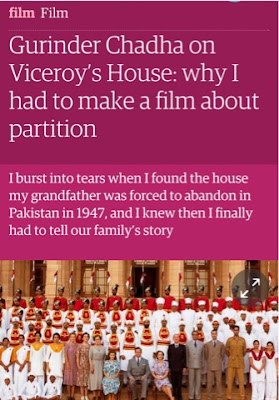
Viceroy's House: film about India-Pakistan 1947 partition
Really looking forward to 'Bend It Like Beckham' director Gurinder Chadha's next film, Viceroy's House, due out next year. It certainly has a cracking cast in Hugh Bonneville, Gillian Anderson, Simon Callow, Om Puri and Huma Qureshi :
Gurinder Chadha's films are always a treat especially to second-gen onwards Brit-Asians such as myself though they certainly have a wider appeal. I also happen to hail from the director's same West London suburb and from a Sikh-Punjabi background so her material particularly resonates with me and it's always interesting to see what she's homing in on. Every Punjabi family has a partition story - I'm curious to see how she handles hers and how she mediates it within the grammar of film-making and the demands of commercial cinema.
In a more recent interview from this month, this time an event at America's Clark University, we learn that:
"Chadha is currently in the post-production phase of her film, “Viceroy’s House,” which will be released in 2017. The film chronicles the British partition of India and Pakistan, and the intertwining of many cultural perspectives during a controversial time in South Asian history. “I was very clear that this is a film made by a British Punjabi; it’s very much that perspective,” said Chadha. “No Indian could have made it, and no Pakistani could have made it, and no white British could have made it.”
“Viceroy’s House” tells Chadha’s family history. “When I was growing up I had come to understand that partition happened because it was our fault — that we Hindus, Sikhs, and Muslims couldn’t get on with each other,” Chadha recalled. “There was violence and the British had no option but to divide the country. … As a result I had somehow felt that the loss of a homeland was a result of my ancestors’ fault.” Chadha said that when archived historical documents eventually became public, she and her family learned the partition was a political act."
Read more from this event here.
In a more recent interview from this month, this time an event at America's Clark University, we learn that:
"Chadha is currently in the post-production phase of her film, “Viceroy’s House,” which will be released in 2017. The film chronicles the British partition of India and Pakistan, and the intertwining of many cultural perspectives during a controversial time in South Asian history. “I was very clear that this is a film made by a British Punjabi; it’s very much that perspective,” said Chadha. “No Indian could have made it, and no Pakistani could have made it, and no white British could have made it.”
“Viceroy’s House” tells Chadha’s family history. “When I was growing up I had come to understand that partition happened because it was our fault — that we Hindus, Sikhs, and Muslims couldn’t get on with each other,” Chadha recalled. “There was violence and the British had no option but to divide the country. … As a result I had somehow felt that the loss of a homeland was a result of my ancestors’ fault.” Chadha said that when archived historical documents eventually became public, she and her family learned the partition was a political act."
Read more from this event here.
Labels:
British-Asian,
cross-cultural,
Film,
India,
Indian cinema,
media,
migration,
Punjabi diaspora,
race,
Sikh/Hindu/Muslim,
Southall,
what's on
Sunday, 6 April 2014
West meets East: from Eltham, England, to Punjab, India
So finally we are taking the children to visit India, the place from which my family hail, and from whence my parents emigrated to the UK in the early 1960s. It was in London that my brother and I were then born and where we have made our own lives.
My husband, however, is not from an Indian background, his family being born and bred south Londoners for generations. All these factors hare inevitably meant that our children's bi-culturality is a bit lop-sided. Despite the best implorings of my mother, my talking in Punjabi regularly to my children in an otherwise English setting just didn't happen. And so, after all these years of only hearing about India and being touched by Indian culture in a peripheral way, our children will finally get to see the place and meet some extended family. My husband has done this once before, 14 years ago, the year we were married when, with the eagerness of a newly-wed he foolishly agreed to meet more of the the in-laws.
I have been to India many times before I was married, though less so in the last couple of decades. Incongruously, my brother and I were even sent back for a few months of boarding school there, near Simla, in our primary school years, while my mother was in the UK. A madness that my mother soon changed her mind about, hence the short time there.
It was really at my mother's encouragement that we have set up this current trip. She still visits India frequently, having siblings and nephews/nieces there, and around 2002 she finally bought her own little house in the Punjabi new town of Chandigarh. Not getting any younger, she was very keen to show our kids 'her manor' and to show them off to family there. She and my brother will be traveling to India a week earlier and will meet us there.
The visit is most significant for me because of our children. It's that strange diasporic phenomena of having perhaps emotionally separated from your heritage country, and even having ambivalent feelings about it, yet despite this so wanting your children to have an attachment to it. An Irish acquaintance tells me that this is exactly his experience when taking his children back to Ireland for the first time. It's a strange crossroads of a time when all sorts of repressed emotions come to the fore, questions of identity and belonging, which perhaps you had not really appreciated before. But also looking back on my younger years and musing that, what may be generational differences within some families, in a diasporic family these also become interwoven with cultural differences between the different generations.
But back to the trip - we'll be visiting the northerly state of Punjab, which borders Pakistan of course, flying in to New Delhi and then basing ourselves in Chandigarh, at my mother's house. More of that later, but let me set the geographical scene...
So here's a map (click on images to enlarge) of the upper half of India, with its capital, New Delhi, in the north. Our time there will only touch the NW area of the vast land that is India, and within the state of Punjab.
This is the territory that our 12 day trip will cover, with the main places of staying/visiting marked out.
We've got this tentative itinerary planned, but this will very much depend on the pace, and the heat, that we and children can cope with once there:
Day 1
Tue and Wed: Chandigarh
And so finally we will get to spend some time at my mother's place in Chandigarh. Known as the 'City Beautiful', Punjabis are very proud of having India's first 'planned city', as famously designed by Swiss-born French architect Le Corbusier. He was commissioned by Jawaharlal Nehru, India's first prime minister, to build a city that would replace Lahore, the previous capital of the Punjab lost to newly created Pakistan after partition in 1947.
My husband, however, is not from an Indian background, his family being born and bred south Londoners for generations. All these factors hare inevitably meant that our children's bi-culturality is a bit lop-sided. Despite the best implorings of my mother, my talking in Punjabi regularly to my children in an otherwise English setting just didn't happen. And so, after all these years of only hearing about India and being touched by Indian culture in a peripheral way, our children will finally get to see the place and meet some extended family. My husband has done this once before, 14 years ago, the year we were married when, with the eagerness of a newly-wed he foolishly agreed to meet more of the the in-laws.
I have been to India many times before I was married, though less so in the last couple of decades. Incongruously, my brother and I were even sent back for a few months of boarding school there, near Simla, in our primary school years, while my mother was in the UK. A madness that my mother soon changed her mind about, hence the short time there.
It was really at my mother's encouragement that we have set up this current trip. She still visits India frequently, having siblings and nephews/nieces there, and around 2002 she finally bought her own little house in the Punjabi new town of Chandigarh. Not getting any younger, she was very keen to show our kids 'her manor' and to show them off to family there. She and my brother will be traveling to India a week earlier and will meet us there.
The visit is most significant for me because of our children. It's that strange diasporic phenomena of having perhaps emotionally separated from your heritage country, and even having ambivalent feelings about it, yet despite this so wanting your children to have an attachment to it. An Irish acquaintance tells me that this is exactly his experience when taking his children back to Ireland for the first time. It's a strange crossroads of a time when all sorts of repressed emotions come to the fore, questions of identity and belonging, which perhaps you had not really appreciated before. But also looking back on my younger years and musing that, what may be generational differences within some families, in a diasporic family these also become interwoven with cultural differences between the different generations.
But back to the trip - we'll be visiting the northerly state of Punjab, which borders Pakistan of course, flying in to New Delhi and then basing ourselves in Chandigarh, at my mother's house. More of that later, but let me set the geographical scene...
So here's a map (click on images to enlarge) of the upper half of India, with its capital, New Delhi, in the north. Our time there will only touch the NW area of the vast land that is India, and within the state of Punjab.
This is the territory that our 12 day trip will cover, with the main places of staying/visiting marked out.
We've got this tentative itinerary planned, but this will very much depend on the pace, and the heat, that we and children can cope with once there:
Day 1
Sun:
Overnight flight To New Delhi from Heathrow
(we've pushed the boat out and will be flying in Virgin's 'Premium Economy' class - here's the oh-so-important additional 'luxuries' you get, that mean you can look down on Economy, though still look 'up' to Upper Class - a bit like the 1960s sketch with Cleese and the Ronnies...I think a good linen tablecloth is always an essential... We decided that the kids could best cope with the 8-9 hrs flight if they slept overnight, especially as we still have the 5-6 hour drive to Chandigarh ahead once we land. Let's see how that works out...)
Day 2
Mon:
Arrive at New Delhi
(to be met by the car which mum will have sent ahead - that should be interesting trying to find the driver in the busy airport...)
Drive, 5-6 hours
to Chandigarh
This will be along the (in)famous Grand Trunk Road, one of Asia's oldest roads apparently, and much eulogized in various Punjabi songs - a bit like America''s 'Route 66'. We'll be stopping for lunch at one of the 'dhabas' (or roadside cafes) which Punjab is well-known for.
Day 3 and 4This will be along the (in)famous Grand Trunk Road, one of Asia's oldest roads apparently, and much eulogized in various Punjabi songs - a bit like America''s 'Route 66'. We'll be stopping for lunch at one of the 'dhabas' (or roadside cafes) which Punjab is well-known for.
Tue and Wed: Chandigarh
And so finally we will get to spend some time at my mother's place in Chandigarh. Known as the 'City Beautiful', Punjabis are very proud of having India's first 'planned city', as famously designed by Swiss-born French architect Le Corbusier. He was commissioned by Jawaharlal Nehru, India's first prime minister, to build a city that would replace Lahore, the previous capital of the Punjab lost to newly created Pakistan after partition in 1947.
Day 5
Thurs : the village tour
Leave
very early to travel to west Punjab by car (3.5hrs) to my mother's ancestral village
home, and the villages of some nearby relatives (area around no. 3, Moga, on
the map). My mother has very efficiently pre-informed various relatives about
when we will be arriving at each of them and how long we will stay at each.
This is to avoid, very wisely, the protracted insistence at each place on
extended hospitality involving long elaborate meals. Stay overnight at cousin's
house.
Day 6
Friday: travel to Amritsar
Leave
after lunch for Amritsar (2.5hrs by car), the most northerly place we'll be visiting and only
about 35 mins from the Pakistan border. This is the site, of course, of the
so-called 'Golden Temple' or to give it its proper name, 'Sri Harmandir Sahib'.
It is the holiest of places for Sikhs to visit, akin to a Sikh Vatican. It was
in the UK news this February when
archived papers revealed the hitherto unknown involved of the British
government in the events of 1984 at the Temple - this was when the Indira
Gandhi's government unleashed a violent attack on the Temple, killing many
people (575 officially, more unofficially). Amritsar is also the site of the Jallianwala Bagh massacre, also known as the
Amritsar massacre, in April 1919. That atrocity was depicted at length in
Attenborough's Gandhi film.
We hope
to visit both these places - one very beautiful, the other very poignant.
Amritsar
is an iconic Punjabi city - steppeed in history, narrow cobbled lanes and
famous for its food and 'chic/vintage traditional' fashion shopping, We
plan to stay overnight in a nice hotel, hopefully with swimming pool to give
the kids some fun. We might also, if time, visit the Waggah border ceremony at
dusk - famous for its nightly ritualistic and exaggerated 'closing of the
gates' ceremony between the Indian and Pakistan border, as depicted on an episode of Michael Palin: "a masterly
display of just how angry you can get without hitting anything!"
Day 7
Sat:
Early breakfast at Amritsar hotel, swim, pack, travel back to Chandigarh (4.5hrs)
Day 8, 9, 10
Sun, Mon, Tues: in Chandigarh.
On Sunday - celebrating Vaisaiki, the birth of the
Sikh religion.
Day 11
Wed: Travel To Delhi
Check in to hotel, explore Delhi and celebrate daughter’s birthday, maybe at Connaught
Place’s TGIF, to give her something familiar.
Day 12
Thurs: Delhi sightseeing
Breakfast in Delhi Hotel, browse Chandi Chawk ('moonlight place') an ancient
shopping site, visit the 16th century Mogul Red Fort, cool off
by the pool in the afternoon and explore the markets in the
evening (hmm..bit ambitious this day)
Day 13
Fri: hotel then fly home
Leave for
Delhi airport and flight back home to UK.
And that,
my friends, is the plan! Let's see how it works out. We're quite relaxed about
changing things where we want to, and go with the flow, but you've got to have
an aim, haven't you?
Our trip
will have the added interest of a little election going on in India - the
election of the 16th Prime Minister of independent India, by over 814 million
citizens over six weeks of voting beginning 7 April. The front runner could
unfortunately see India having its first non-secular leader, against the spirit of the constitution established by the first PM Nehru.
Lots more
I could write, but another time...so adios, ciao and namaste. We out.
Labels:
British-Asian,
children,
cross-cultural,
history,
holiday,
India,
migration,
Punjabi diaspora,
race,
Sikh/Hindu/Muslim
Monday, 19 March 2012
Update on the 'big fat' wedding
Well, it was, of course, a lovely event (my previous post about the wedding we were going to last weekend). I posted these two photos via twitter during the event, trying not to invade anyone's privacy too much (click to enlarge). However, the first dance of the bridal couple (here in the pic above) was a real paparazzi event - not very romantic though the couple only had eyes for each other.
I didn't get any closer to exactly how my family were related to the wedding couple though I did hear some charming and nostalgic stories from my mother about how she remembered various people there when they were toddlers, toddling around the village, being baby-sat by her and her sisters, in the state of Punjab, India. That all seemed so far away, many grim London rented rooms, double factory shifts and sacrifices away. The community now at this opulent wedding were a confident, financially secure, and more relaxed group than those early days of struggle. That felt good.
p.s the aunt and her family with whom my mother had fallen out never showed! So all was good in the wood.
Friday, 16 March 2012
Big, fat* Indian wedding
Yes, we are attending one tomorrow. More specifically, a Sikh Punjabi 'do'. The wedding is of a relative who hails from the Nottingham branch of the family. But don't ask me how we are related - I have no idea. My mother, at whose behest we are attending, launches into great details about the aunt-of, the cousin-of, the niece's husband's sister-in-law, but I am none the wiser! I need a diagram. Trouble is, I lose interest half way through...
We are all ready with our outfits, and will travel over tomorrow to my mother's to the west of London, near hounslow/heathrow. As you can see my outfit is particularly sparkly, yes, it reminds me too of a xmas tree. Unfortunately I didn't have time (or frankly, the inclination) to spend hours searching for something more sophisticated. The children (8 & nearly 10) are excited about going to an 'Indian party'. It's been ironic that I've turned to British descriptions of Indian dancing to explain to my inquisitive daughter how it's done - yes, the old change the light bulb with one hand, and pat the dog with the other, at the same time...(some people really do dance like that, but there are plenty of other moves too).
My mother is very excited to be attending such an event with her whole family, especially with all her grandchildren around her, something which happens increasingly less. But there will be an element of frisson in the mix tonight - in good old family tradition, there has for years been a schism between my mother and her sister which means that that they, and their supporters, don't talk to each other! This will be tricky to negotiate tomorrow night especially because I find it difficult to be (knowingly) rude to people. I shall take the 'third way' I think. There will be lots of showing-off and one-upmanship tomorrow night about who's got the best car, clothes, house, most successful children etc. I won't enter that race (much to my family's annoyance).
Lord knows what my (non-Asian) husband makes of it all - he goes along with it all very sportingly. I guess he married the package...
Aside from all this (!) I'm looking forward to it!
We are all ready with our outfits, and will travel over tomorrow to my mother's to the west of London, near hounslow/heathrow. As you can see my outfit is particularly sparkly, yes, it reminds me too of a xmas tree. Unfortunately I didn't have time (or frankly, the inclination) to spend hours searching for something more sophisticated. The children (8 & nearly 10) are excited about going to an 'Indian party'. It's been ironic that I've turned to British descriptions of Indian dancing to explain to my inquisitive daughter how it's done - yes, the old change the light bulb with one hand, and pat the dog with the other, at the same time...(some people really do dance like that, but there are plenty of other moves too).
My mother is very excited to be attending such an event with her whole family, especially with all her grandchildren around her, something which happens increasingly less. But there will be an element of frisson in the mix tonight - in good old family tradition, there has for years been a schism between my mother and her sister which means that that they, and their supporters, don't talk to each other! This will be tricky to negotiate tomorrow night especially because I find it difficult to be (knowingly) rude to people. I shall take the 'third way' I think. There will be lots of showing-off and one-upmanship tomorrow night about who's got the best car, clothes, house, most successful children etc. I won't enter that race (much to my family's annoyance).
Lord knows what my (non-Asian) husband makes of it all - he goes along with it all very sportingly. I guess he married the package...
Aside from all this (!) I'm looking forward to it!
There may be some 'live-tweeting' from the wedding, now that I've got my new smart phone, if I'm not too busy with kids, relatives at war, and busting a few of my own moves...
*bit loathe to use this phrase given the horrible trouble caused by the Channel4 programme recently, but I don't want to lose it altogether because, since the 'Big Fat Greek' wedding days, it has been a really apt and useful phrase to describe a particular type of diasporic event
Sunday, 4 September 2011
London Mela today
The mela festival season has unfortunately passed me by this year. This is a quick mention though that the biggest of them, the London Mela takes place today, between 1pm and 8.30pm at Gunnersbury Park, which is on the Hounslow/ Ealing borders.
It's billed as the UK's largest Asian mela and has "seven zones with urban, classical and experimental music, DJs, circus, dance, visual arts, comedy, children’s area; food from around the world. Pop and classical music, cabaret, cultural stalls, martial arts, street theatre. Free entrance, but parking charge.. It's supporting the British Heart Foundation charity.
The biggest names performing there today include Jay Sean, Jazzy B and Mumzy Stranger. As you can see, even Boris Johnson. Mayor of London, enjoys honing his skills at the Mela (believe me, 'change the light bulb while patting the dog' does work sometimes...well, if you're an aunty-ji)
BBC Asian Network will be filming the London Mela Main Stage for their BBC TV ‘A Summer Of Melas’ Red Button special. Just press the Red Button on your remote control from tomorrow (Monday 5th September) to watch Mela highlights. For full information go to: www.bbc.co.uk/asiannetwork
It's billed as the UK's largest Asian mela and has "seven zones with urban, classical and experimental music, DJs, circus, dance, visual arts, comedy, children’s area; food from around the world. Pop and classical music, cabaret, cultural stalls, martial arts, street theatre. Free entrance, but parking charge.. It's supporting the British Heart Foundation charity.
The biggest names performing there today include Jay Sean, Jazzy B and Mumzy Stranger. As you can see, even Boris Johnson. Mayor of London, enjoys honing his skills at the Mela (believe me, 'change the light bulb while patting the dog' does work sometimes...well, if you're an aunty-ji)
BBC Asian Network will be filming the London Mela Main Stage for their BBC TV ‘A Summer Of Melas’ Red Button special. Just press the Red Button on your remote control from tomorrow (Monday 5th September) to watch Mela highlights. For full information go to: www.bbc.co.uk/asiannetwork
See here for my more substantial piece on Asian melas in 2010.
Labels:
Bollywood,
British-Asian,
cross-cultural,
London event,
music,
Punjabi diaspora,
Sikh/Hindu/Muslim,
what's on
Tuesday, 15 March 2011
Axe freezes over BBC Asian Network
![]() |
| Alesha Dixon at the Asian Music Awards |
"The BBC has reversed its decision to close the Asian Network digital radio station – but will look to cut its budget in half....
BBC executives are understood to have concluded that a national digital radio station remains the best way to reach Asian listeners, rather than a collection of medium-wave services that was mooted as one possible replacement.I must admit that only last night I enjoyed using the 'interactive red button' thingy on the BBC Asian Network via Freeview, to watch last week's UK AMAs at the Roundhouse in Camden, London. The Asian Music Awards are like the Asian MOBOs and reflect a growing and influential music scene - I don't think those awards were broadcast anywhere else, at least I'm not aware (and didn't Alesha look great in a sari - she was there along with Tim Westwood, Apache Indian, Jay Sean and a lot of younger people!)
The station's audience has already increased by about a third since the closure plan was announced in March 2010 and it had an average weekly reach of 477,000 listeners in the final three months of last year. Management is expected to demand a further increase in its audience, as well as cutting Asian Network's budget." More here.
Labels:
British-Asian,
cross-cultural,
media,
music,
Punjabi diaspora
Saturday, 5 February 2011
PM in trouble turns to an old favourite
Wake up today to the BBC headline "Multiculturalism has failed - PM" about "his first speech as prime minister on radicalisation and the causes of terrorism." He is making this speech in Germany, of all places. Perhaps he's trying to impress Merkel given her recent foray. Mostly I'm dumbfounded about his timing - he's making this speech on a day when thousands of people like this:
are marching in Luton today, along with right-wing fascists from all over the country. There is certainly a debate to be had about terrorism and the disengagement of young people in all communities, and we'll have to see the full text of his speech later but the constant equation of Islam and terrorism is wrong. And today of all days? (Wonder what the Baroness Warsi will have to say about this...)
Liked these tweets from earlier today:
are marching in Luton today, along with right-wing fascists from all over the country. There is certainly a debate to be had about terrorism and the disengagement of young people in all communities, and we'll have to see the full text of his speech later but the constant equation of Islam and terrorism is wrong. And today of all days? (Wonder what the Baroness Warsi will have to say about this...)
Liked these tweets from earlier today:
On a day of the EDL demo when Cameron could have made a more interesting speech abt what binds is together, Tories go back to hectoring tone
Oh and as Mr Cameron lectures Muslims today, the EDL will be threatening them with their biggest ever rally in Luton. http://j.mp/dV6cjh
Shared British values Mr Cameron? How about the NHS, public libraries, national parks and woodlands and universities for a start?
RT @8minstosunrise: Cameron turning to racism when government in trouble. Racism always used to divert attention from what's taking place.
Labels:
British-Asian,
cross-cultural,
history,
media,
politics,
race,
Sikh/Hindu/Muslim
Sunday, 2 January 2011
Sarfraz Manzoor gets married
This British story of love, "inter-racial", "cross-religion" marriage, class difference, marrying out etc. managed to pass me by this autumn...
Sarfraz Manzoor, Guardian and Observer writer and increasingly 'commentator' on TV and radio, writes quite movingly, and surprising frankly, about his own personal life.
Last September in the Guardian, "My mother and siblings were angry that I had fallen in love with a non-Muslim white woman" but would they attend the wedding?
Manzoor updated the story last December when I caught it, in 'what happened next...The writer's marriage in the summer to a white non-Muslim split his family"
In the post-article comments he gets it from all angles - 'it's wonderfully moving', he shouldn't be diluting his culture, he's not diluting it enough, he's racist towards white women, he's sexist towards Muslim women, he's 'marrying out' up the ethnic ladder. Personally I found it a fascinating story - he may or may not be a bit or all of these things, but the story is true and seems honest.
In these days of mixed societies the story will have some resonance for many readers. As a brown Brit (nominally Sikh) married to a white man (nominally Christian) I can empathise with the situation in some respects. I wish them the best.
Sarfraz Manzoor, Guardian and Observer writer and increasingly 'commentator' on TV and radio, writes quite movingly, and surprising frankly, about his own personal life.
Last September in the Guardian, "My mother and siblings were angry that I had fallen in love with a non-Muslim white woman" but would they attend the wedding?
Manzoor updated the story last December when I caught it, in 'what happened next...The writer's marriage in the summer to a white non-Muslim split his family"
In the post-article comments he gets it from all angles - 'it's wonderfully moving', he shouldn't be diluting his culture, he's not diluting it enough, he's racist towards white women, he's sexist towards Muslim women, he's 'marrying out' up the ethnic ladder. Personally I found it a fascinating story - he may or may not be a bit or all of these things, but the story is true and seems honest.
In these days of mixed societies the story will have some resonance for many readers. As a brown Brit (nominally Sikh) married to a white man (nominally Christian) I can empathise with the situation in some respects. I wish them the best.
Labels:
British-Asian,
cross-cultural,
media,
migration,
race,
Sikh/Hindu/Muslim
Saturday, 20 November 2010
Largest Sikh temple outside of India?
It was a co-incidence that for the last couple of days I have been in Chatham, North Kent, for a work event because down the road from there a remarkable building has been built.
Yesterday was the formal opening of the Guru Nanak Darbar Gurdwara, a Sikh place of worship. This incredible building, off Saddington Street in Gravesend, Kent, is believed to be one of the largest Gurdwaras in the UK and perhaps outside of India.
The remarkable aspect is that the cost so far of £12m or so has been entirely voluntarily contributed, and so has some of the labour to build it. The project started eight years ago. There are apparently about 12,000 Sikhs in Gravesend. I think the overall UK Sikh population is about 500,000 last time I checked. Some of the earliest Sikh settlers in the UK in fact lived in Gravesend although most attention is often focused on Southall in West London as being the heart and soul of southern England's Sikh community - there is a Channel 4 documentary about the Gravesend Sikhs which I must locate again (be grateful for any links...)
The new Gurdwara has been built on the site of the previous the Gurdwara which opened 41 years ago, in November 1969 - click here to see black and white photos of the opening event all those years ago (I always love to see early immigration photos, of whichever community - they encode so much about the time.)
Sikhs are famously known to be a convivial people (though I guess I'm a bit biased!) and very welcoming of interfaith connections - for example, two years ago the the Deans of Rochester Cathedral and Canterbury Cathedral (photo left) visited the new gurdwara site to plant trees in the grounds.
Back to the future, the new building looks very impressive. The President of the Gurdwara Management committee, Jaspal Singh Dhesi, has said that the building "gives Gravesend an international landmark that will be here to serve many generations.” As with most such places it welcomes school visit, contact them through their website.
The opening date for the new Gurdwara has been chosen as it coincides with
541st Birthday of Guru Nanak Sahib Ji, the founder of the Sikh faith - a service will be held at the Gurdwara on Sunday 21 November.
The BBC has lots of pictures of the new gurdwara here.
Yesterday was the formal opening of the Guru Nanak Darbar Gurdwara, a Sikh place of worship. This incredible building, off Saddington Street in Gravesend, Kent, is believed to be one of the largest Gurdwaras in the UK and perhaps outside of India.
The remarkable aspect is that the cost so far of £12m or so has been entirely voluntarily contributed, and so has some of the labour to build it. The project started eight years ago. There are apparently about 12,000 Sikhs in Gravesend. I think the overall UK Sikh population is about 500,000 last time I checked. Some of the earliest Sikh settlers in the UK in fact lived in Gravesend although most attention is often focused on Southall in West London as being the heart and soul of southern England's Sikh community - there is a Channel 4 documentary about the Gravesend Sikhs which I must locate again (be grateful for any links...)
The new Gurdwara has been built on the site of the previous the Gurdwara which opened 41 years ago, in November 1969 - click here to see black and white photos of the opening event all those years ago (I always love to see early immigration photos, of whichever community - they encode so much about the time.)
Back to the future, the new building looks very impressive. The President of the Gurdwara Management committee, Jaspal Singh Dhesi, has said that the building "gives Gravesend an international landmark that will be here to serve many generations.” As with most such places it welcomes school visit, contact them through their website.
The opening date for the new Gurdwara has been chosen as it coincides with
541st Birthday of Guru Nanak Sahib Ji, the founder of the Sikh faith - a service will be held at the Gurdwara on Sunday 21 November.
The BBC has lots of pictures of the new gurdwara here.
Labels:
British-Asian,
cross-cultural,
history,
India,
migration,
Punjabi diaspora,
Sikh/Hindu/Muslim,
south-east London,
Southall
Saturday, 6 November 2010
No Diwali!
This year I have failed miserably to mark Diwali, which was yesterday. We were due to visit my mother's but plans changed and other life-things took over. Like going to work, like going to school, and being generally exhausted. So there were no diyas (candle things), no burfi (sweetmeats) and no lashings of yummy Indian food. Angela Merkel would approve. I don't live in an Indian community and nor is my husband Indian so it always takes a special effort to mark the day. (I must say it's been a particularly explosive week at work, and one well-covered in the media, but I decided long ago that professionally it was not a good idea to go anywhere near blogging about work, or even to 'come out' about my identity, and so, 'Raven' it is, for now...).
But back to Diwali. I regret not having made an effort for the sake of my kids who would have at least got to experience one special Indian day, amongst the host of other celebrations that they get to enjoy. Must 'try harder' next year... In the meantime I can only repeat below my Diwali post from last year.
I came across a nice piece yesterday which explained why Sikhs (and Hindus) celebrate Diwali (though still not the co-incidence of them falling on the same day):
Happy Diwali and a Happy New Year!
But back to Diwali. I regret not having made an effort for the sake of my kids who would have at least got to experience one special Indian day, amongst the host of other celebrations that they get to enjoy. Must 'try harder' next year... In the meantime I can only repeat below my Diwali post from last year.
"Saturday, 17 October 2009
Happy Diwali
I kinda liked this photo which came across my radar - it's the big smile on the face of President Barack Obama, last Wednesday, lighting "the official White House "diya" to mark the celebration of Diwali, a Hindu festival that will be celebrated by Hindus, Jains and Sikhs around the world this weekend. A local Hindu priest from Maryland recited the mantra as Obama lighted the lamp." [credit: SAJAForum]
Anyways, we're West London bound to my mother's for the Diwali weekend. Not that I am of the religious variety, but the children enjoy it, just like Christmas, and I appreciate the beauty and history of it all. Hubby gets to eat lots of Indian sweets and gets fussed over. The kids, hubby and me get to light a candle at the local gurdhwara (sikh temple) and I might get to find out the answer to that eternal question that's always puzzled me - what's the explanation for the amazing co-incidence of Hindus and Sikhs celebrating Diwali on exactly the same day but for totally different reasons? Can anyone enlighten me? (I can't ask my mum because I don't know how to say 'co-incidence' in Punjabi..."
"In Sikhism, the festival commemorates the return of the 6th Sikh Guru Hargobind to the city of Amritsar after his imprisonment in Gwalior Fort by the Mughal emperor Jahangir, as the Golden Temple along with the whole city had been decorated with lamps to celebrate the Guru’s return. Sikhs also refer to Diwali as Bandi Chhor Diwas, meaning “Day of the Release of Prisoners”, as the Guru had arranged for 52 royal political prisoners to be simultaneously freed from the fort... North Indian Hindus in general celebrate Diwali primarily to mark the return of the Hindu deity Rama to the city of Ayodhya after his victory over Ravan, as described in the Ramayana. Many Hindus also celebrate the festival for a range of other reasons, including offering prayers to the Hindu goddess Lakshmi so that she blesses their families with prosperity during the following year. Public decorations of lights to mark the occasion are common worldwide wherever there are sizeable Hindu populations."That post also included what I thought would be a too-religious-for-atheist-little-me video clip. But I played it and found it to be a haunting piece of music - it's Mitr Pyare Nu by Jagjit Singh (btw it features the 'golden temple" in Amritsar which I have visited a couple of times, a beautiful meditative place).
Happy Diwali and a Happy New Year!
Labels:
British-Asian,
children,
cross-cultural,
India,
music,
Punjabi diaspora,
Sikh/Hindu/Muslim
Wednesday, 3 November 2010
New Asian cool not so new
Just before ‘cool Britannia’ emerged in the early/mid-1990s onwards (Blur, Oasis, Geri in a Union flag dress), the ‘new Asian cool’ was also quietly taking off - Madonna in henna and bindis, Nitin Sawhney, and Goodness Gracious Me (just to condense a decade into a trite sentence!). Since then a host of British Asian cultural artists have become household names and the infamous claims about chicken tikka masala have become legendary.
Now, in a move surely designed to enrage the Daily Fail reader, a new book traces the long standing influence of South Asian textiles on British cultures of fashion, dress and design.
A collaboration between geographers at Royal Holloway, University of London and the V&A Museum has resulted in the launch of a new book ‘British Asian Style: Fashion and Textiles, Past and Present’ co-edited by Christopher Breward, Philip Crang and Rosemary Crill.
"The book is one of the public outputs of ‘Fashioning Diaspora Space’, a project funded by the Arts and Humanities Research Council as part of its Diasporas, Migration and Identities research programme....
This book is illustrated with an array of vivid images from the V&A's exceptional collections, alongside contemporary photographs from street fashion and the catwalk. South Asian textiles have shaped British fashion and dress for centuries, from the fashionable chintzes of the seventeenth and eighteenth centuries, through the silk and paisley Boteh patterns of the nineteenth century, to the orientalism of 1960s Bohemian fashion and the street styles of British Asian youth and designers today. British Asian Style looks at the on-going importance of South Asian textiles to British culture and fashion, as styles move into the mainstream....
British Asian Style shows how the South Asian presence in British culture has been apparent for centuries rather than being just a recent phenomenon...”
British Asian Style was published by V&A Publishing on 25 October 2010. I can't find much out there about this book yet so I don't think it's been picked up yet. The material is certainly fascinating - I must try to get a look at a copy (though I don't think Eltham Library will be stocking it any time soon...).
The AHRC's Diaspora research programme has funded some interesting projects, esp. around the 'British Asian' theme, which I hope to get time to blog about sometime. In the meantime, let me know if you get a look at this book and what you thought.
Related post:
William Morris' art influenced by Islam
Related post:
Labels:
British-Asian,
cross-cultural,
history,
India,
migration,
Punjabi diaspora
Thursday, 28 October 2010
Anjali Joseph says 'no labels' please
A quick mention of a nice piece in last Sunday's Independent about one of the authors included in the DSC South Asian Literature Festival (dscsouthasianlitfest.com). The piece is about Anjali Joseph, author of first novel Saraswati Park, and is quite interesting on identity and 'diaspora writing'...
"Anjali Joseph: 'Stop trying to label me!'
The novel, and the author, sound intriguing - definitely one for the ever-growing reading list...Born in Bombay, educated in Cambridge – and dismissive of tags of nationhood for her debut novel, Anjali Joseph makes a combative case for a better understanding of modern, fluid identity.Back in 1985, when I was seven, my family moved to England from Bombay. My father was a research scientist. He was going to teach at Warwick University. In his first week, a colleague offered to take him to the cafeteria at the campus arts centre. There were sandwiches, salads, baked potatoes, and something else, which the colleague indicated: "Have you tried these? They're called samosas. They're rather good...." Read the rest here.
By the way, discovered this nifty 'browse this book' site where you can read the first 53 pages or so, on the publisher's website naturally.
Kind of related posts:
A new Anthology of British Asian writing
Indian authors writing in English
Monica Ali on Fiction
Anita Desai and Kiran Desai in conversation
'Chick Lit'
Subscribe to:
Posts (Atom)