Showing posts with label Southall. Show all posts

Tuesday, 15 November 2016

Viceroy's House: film about India-Pakistan 1947 partition

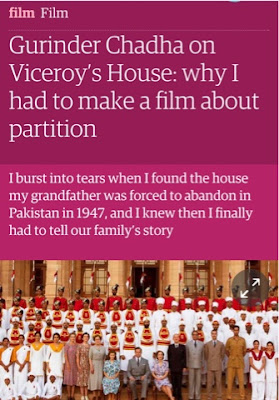
Really looking forward to 'Bend It Like Beckham' director Gurinder Chadha's next film, Viceroy's House, due out next year. It certainly has a cracking cast in Hugh Bonneville, Gillian Anderson, Simon Callow, Om Puri and Huma Qureshi :
https://www.theguardian.com/world/2016/apr/16/gurinder-chadha-on-viceroys-house-why-i-had-to-make-a-film-about-partition?CMP=share_btn_tw

Gurinder Chadha's films are always a treat especially to second-gen onwards Brit-Asians such as myself though they certainly have a wider appeal.  I also happen to hail from the director's same West London suburb and from a Sikh-Punjabi background so her material particularly resonates with me and it's always interesting to see what she's homing in on. Every Punjabi family has a partition story - I'm curious to see how she handles hers and how she mediates it within the grammar of film-making and the demands of commercial cinema.

In a more recent interview from this month, this time an event at America's Clark University, we learn that:

"Chadha is currently in the post-production phase of her film, “Viceroy’s House,” which will be released in 2017. The film chronicles the British partition of India and Pakistan, and the intertwining of many cultural perspectives during a controversial time in South Asian history. “I was very clear that this is a film made by a British Punjabi; it’s very much that perspective,” said Chadha. “No Indian could have made it, and no Pakistani could have made it, and no white British could have made it.”

“Viceroy’s House” tells Chadha’s family history. “When I was growing up I had come to understand that partition happened because it was our fault — that we Hindus, Sikhs, and Muslims couldn’t get on with each other,” Chadha recalled. “There was violence and the British had no option but to divide the country. … As a result I had somehow felt that the loss of a homeland was a result of my ancestors’ fault.” Chadha said that when archived historical documents eventually became public, she and her family learned the partition was a political act."

Read more from this event here.

Sunday, 12 December 2010

On the buses

I came across this excellent blog - London buses: one bus at a time. It seems that some intrepid retired ladies set out to travel the whole length of any given bus, one at a time, and then give us a little write-up of their what they see, complete with little bits of history, links and their photos. Locally I was interested to read about:

- the 124 bus, Catford to Eltham High Street
- the 126, Eltham Crescent to Bromley South and
- the 122, Crystal Palace to Plumstead

and for those from the other side of London town, hailing from my childhood towns of Northolt and Southall, the 120 is covered - Northolt Station to Hounslow Bus Station.

Saturday, 20 November 2010

Largest Sikh temple outside of India?

It was a co-incidence that for the last couple of days I have been in Chatham, North Kent, for a work event because down the road from there a remarkable building has been built.

Yesterday was the formal opening of the Guru Nanak Darbar Gurdwara, a Sikh place of worship. This incredible building, off Saddington Street in Gravesend, Kent, is believed to be one of the largest Gurdwaras in the UK and perhaps outside of India.

The remarkable aspect is that the cost so far of £12m or so has been entirely voluntarily contributed, and so has some of the labour to build it. The project started eight years ago. There are apparently about 12,000 Sikhs in Gravesend. I think the overall UK Sikh population is about 500,000 last time I checked. Some of the earliest Sikh settlers in the UK in fact lived in Gravesend although most attention is often focused on Southall in West London as being the heart and soul of southern England's Sikh community - there is a Channel 4 documentary about the Gravesend Sikhs which I must locate again (be grateful for any links...)

The new Gurdwara has been built on the site of the previous the Gurdwara which opened 41 years ago, in November 1969 - click here to see black and white photos of the opening event all those years ago (I always love to see early immigration photos, of whichever community - they encode so much about the time.)

Sikhs are famously known to be a convivial people (though I guess I'm a bit biased!) and very welcoming of interfaith connections - for example, two years ago the the Deans of Rochester Cathedral and Canterbury Cathedral (photo left) visited the new gurdwara site to plant trees in the grounds.

Back to the future, the new building looks very impressive.  The President of the Gurdwara Management committee, Jaspal Singh Dhesi, has said that the building "gives Gravesend an international landmark that will be here to serve many generations.” As with most such places it welcomes school visit, contact them through their website.

The opening date for the new Gurdwara has been chosen as it coincides with
541st Birthday of Guru Nanak Sahib Ji, the founder of the Sikh faith - a service will be held at the Gurdwara on Sunday 21 November.

The BBC has lots of pictures of the new gurdwara here.

Saturday, 9 October 2010

'Uprisings' of the '1980s revisited'

An interesting event coming up at the British Library (especially in view of the current Black History Month - more on that another time...):

Our memories of the uprisings: The 1980s Revisited

Black History Month
Mon 25 Oct 2010, 18.00 - 19.30
Conference Centre, British Library, St Pancras, 96 Euston Road, London, NW1 2DB

Price: £6 / £4 concessions

Book now here
Frequently characterised as 'racial riots', the uprisings of the 1980s in Bristol, Brixton, Toxteth and Moss Side were significant reactions to the politics of late 20th-century Britain. This event will bring together witnesses to offer memories of the uprisings and reflect on their context and legacy. The audience will have an opportunity to share their memories and discuss the socio-historical background to these events.
Speakers include Linda Bellos OBE, Wally Brown CBE and Kunle Olulode.
The run time for this event includes a post-talk reception.  Presented in association with LB Camden Black History Forum.
This event seems to concentrate more on the African-Caribbean experience of the 1980s - 'uprisings' also took place, of course, in west London in Southall where there was an Indian community which was doing battle with racist parties. I've touched on some of those events in these past posts:

Blair Peach and Southall on Newsight now...

A Town under Seige: p.s. to the Southall Story

The Southall Story

Coming out about Bollywood

Kwame Kwei-Armah: a Southall boy

Wednesday, 30 June 2010

Empire State of Mind: Let's hear it for Southall

Regular readers may know that though I've been a South-East Londoner for 20-odd years now, my early and schooling years were spent in and around Southall, an outer West-London suburb with a large Asian community.  So I thought I'd share with you this funny, and actually quite good, parody of J-Zee's Empire State of Mind by Humili-Asian:
"...cos baby I'm from Southall
Concrete jungle where dreams are broken
There's nothing you can do
Now you're in Southall
These streets will try and sell anything as long as its faking
Lets's hear it for Southall, Hounslow, Harrow..."


Click here to check out my other posts about Southall.

Tuesday, 6 April 2010

Asian Alchemy in London

I'm back. Lots to write about - might tell you about Centre Parcs another time - but for now....

Talking about the Indian sub-continent being en vogue at the moment, there is a cracking festival just starting at the South Bank Centre in London. In it's own words: "Alchemy explores the culture of India, its diaspora and its relationship to the UK today in over 30 events spanning dance, music, literature, debates, fashion and food. 

Over five packed days discover classical masters of the sub-continent alongside emerging British Asian talent; folk traditions alongside contemporary experimentation."

The line-up looks fantastic, there just so much here - you can check up the programme here.

In the meantime, here below are some goodies I've picked out - the free showing of Sholay looks fun (orginally pointed out to me by Plummy Mummy) and the Southall Story events sound interesting. I'd be interested to hear about what you thought about any of it:

Credit: Jonah RamballLevel 5 Function Room
India: Global Powerhouse?
Wednesday 7 April 2010
Is India the new America?


A.R. RahmanRoyal Festival Hall
Wednesday 7 April 2010
The London Philharmonic Orchestra performs the works of the celebrated Indian film composer AR Rahman.

Southall Storytellers
Yellow Room, Spirit Level
Tuesday 6 April 2010 - Sunday 11 April 2010
Visit stalls, watch performances and meet local storytellers reminisce about Southall.

Southall StorySpirit Level
Wednesday 7 April 2010 - Tuesday 11 May 2010
The Southall Story explores the recent history of a place that has come to be affectionately known as Little India, but for many it is much more than that.

A Golden Age
Sunley Pavilion
Thursday 8 April 2010
Tahmima Anam's novel 'A Golden Age' is our first book club choice of the new season, and is part of the Alchemy Festival.


H-DhamiQueen Elizabeth Hall
Thursday 8 April 2010
Hosted and curated by Nihal from BBC Radio 1 and BBC Asian Network, this event marks the first time three of the biggest names in UK Bhangra - H-Dhami, Jaz Dhami and Juggy D - perform together

NihalThe Clore Ballroom
Thursday 8 April 2010
BBC Radio 1 DJ, Nihal hosts his BBC Asian Network show live at Southbank Centre. Join a discussion on the ingredients that make up Indian culture today.


Gauri Sharma TripathiPurcell Room
Thursday 8 April 2010
Gauri Sharma Tripathi is a key exponent of the north Indian classical dance form of Kathak.


SamayQueen Elizabeth Hall
Friday 9 April 2010
This evening brings together innovators of Indian dance and music from two different perspectives.


MilunFoyer Bar - level 2
Friday 9 April 2010
By combining the notes found in the standard minor scale in Irish music with well-known ragas in Indian music, Milun conjure musical conversations that exchange traditional motifs

The Teak ProjectThe Front Room at QEH
Friday 9 April 2010
The Teak Project represents a collaboration between three of Britain's finest young improvisers.


Sonia SabriThe Clore Ballroom
Friday 9 April 2010
Hosted and performed by Sonia Sabri and featuring special guest Mavin Khoo this event explores the roots of Indian classical dance.


Alchemy Market - A Taste of IndiaSouthbank Centre Square
Friday 9 April 2010 - Sunday 11 April 2010
During the Alchemy Festival, Southbank Centre Square offers a variety of Indian foods and crafts for you to enjoy, including hot dishes and chai. Come and try the tastes and smells of India.


A Golden AgeBlue Room, Spirit Level
Saturday 10 April 2010
Set amidst the Bangladeshi War of Independence of 1971, 'A Golden Age' is a novel about a country and a family at war.


Aakash Odedra & Sanjukta Sinha/ Seeta Patel & Kamala Devam/ Hetain PatelPurcell Room
Saturday 10 April 2010
This evening brings together several British born-artists investigating their Indian cultural heritage, together with dancers who share this line of enquiry from America and India.

The Southall Story
Yellow Room, Spirit Level
Saturday 10 April 2010
Including performances by Kuljit Bhamra and Mohinder Kaur Bhamra.


Sufi ZenQueen Elizabeth Hall Roof (free)
Saturday 10 April 2010
Highlighting the contrasts between the spiritual stillness of Zen and all-encompassing motion of Sufism

Nathan 'Flutebox' LeeQueen Elizabeth Hall
Saturday 10 April 2010
One ticket buys you a brilliant mini festival line-up of the most innovative artists from UK and India, with live bands and film soundtrack performances, VJs, DJs, spoken word and comedy

The Clore Ballroom (free)
Sunday 11 April 2010
Modern democracies are increasingly concerned about young people disengaging from conventional politics. Youth culture in India is said to be driving a wedge between old and young.

SholayThe Clore Ballroom (free)
Sholay
Sunday 11 April 2010
Southbank Centre marks the close of the Alchemy Festival with a screening of the classic Bollywood film 'Sholay'.

The Grewal FamilyQueen Elizabeth Hall
Sunday 11 April 2010
Southbank Centre brings the stars of the popular Channel 4 series 'The Family' to the stage for the first time.

Saturday, 12 December 2009

Jay Sean goes up with Down

Just over a month ago I noticed something. The Asian diaspora were raving about a first which seemed to have gone un-noticed initially in the 'mainstream' media. It was that Jay Sean, a 28-year old singer, had made it to no.1 in the USA 'Billboard Hot 100 chart' with his single 'Down' - notable because it was the first USA no.1 by a British artist in ages and because it was the first British-Asian one (e.g. BBC Asian Network ran this interview on 12 October).

However, other media soon caught on. I was struck by the headline and double-page spread in the Evening Standard (image above) on 16 November. It goes for the 'transformation' angle - though instead of  the usual 'rags to riches' it's more 'local to global'. JS was afterall training to be a doctor and his parents were 'well-settled' (to use that particular phrase common in diasporic circles).

The Independent also later had this interview. For those not familiar with Jay Sean, the Evening Standard sums up the basic story like this:

"Actually, Jay Sean — real name Kamaljit Singh Jhooti — is a privately educated former medical student from Hounslow, the son of a second-generation Sikh businessman father and a Delhi-born beautician mother. And his “sudden” success is the result of seven years of hard graft and attention to detail. His meticulous management of his own sound and image has seen him walk away from a £1 million record deal with Virgin, set up his own record label, change his musical direction and even choose a stage name free of ethnic connotations in order to offer “a musical product free of labels, agendas and race."

As you can imagine, plenty more angles to be taken up here - for example, there's some debate about whether he could have made it without changing his name (though the answer may lie in snappy marketing rather than racial affiliation). I was also interested in the Jay Sean frenzy because JS is from Hounslow, next door to my old home town Southall, in West London - there are hundreds of musical wannabes there who will be inspired by his story. Good luck to them all (though, like an Indian aunty, I'd have to advise - try and get your education first, eh?)

You can visit lots of YouTube videos to see him in action - amongst them this live performance at the University of Hertfordshire from 2007 in which he also sings in Punjabi too (something he won't be doing a lot more of, I'm guessing).

Oh, and lastly, I look forward soon to seeing this postive success story about an immigrant son on the front pages of the Daily Mail or Express. No? Just saying.

Thursday, 19 November 2009

Getting arty in Southall, West London

Louise Ashcroft has left this interesting invitation on an earlier Southall-related post, to which you might want to respond:
" Hi,
I am an artist making a project about Southall which will be exhibited in a major warehouse exhibition organised by London's Departure Gallery on 10th-13th Dec 2009. I am inviting people to email me info/opinions/images/media inspired by the location of my project, which is in a warehouse on an industrial estate in Southall, west London. I would really like you to email me something to include in the project.

Everything I receive will be exhibited together in a sculptural way and will be labelled with the sender's name. Everyone involved will be credited in the exhibition catalogue. Please respond asap (by 1st December).

This is a great opportunity to showcase your ideas about the local area and to get involved in an interesting project. It need not take much time.

Many thanks.

Louise Ashcroft      industrialestatesouthall@googlemail.com "

Tuesday, 13 October 2009

Blair Peach and Southall on Newsight now...

I shall post a 'listen again' link when it's available [now here at 15.39 mins in]. This is what my email said from Newsnight earlier this evening:
"...it is ...a question that is still unanswered 30 years after the death of a teacher in another London demonstration.

His name was Blair Peach and the Metropolitan police commissioner has finally promised to release the findings of their investigation into his death after keeping them secret since 1979.

It was widely reported at the time that the inquiry recommended charges be brought against individual police officers. Tonight, for the first time, the inspector said to have been a prime suspect speaks about his role in an exclusive report from Peter Marshall."
Marshall has just asked the inspector "did you kill Blair Peach?" "No, no way, I didn't" he said. He's now Dr Alan Murray, an academic, sounding quite sincere and plausible. On the other hand, surely the death of an innocent, peaceful person on a march needs to be accounted for?

The findings of the Met Police investigation will be made public "by the end of the year".

My previous post on Southall and the death of Blair Peach here and the BBC summary, including a clip from the programme here

Tuesday, 22 September 2009

Kwame Kwei-Armah: a Southall boy

Did you know that Kwame Kwei-Armah, playwright and actor, was brought up in Southall (west London, UK)? Perhaps the rest of the world did, but that little nugget has passed me by. I've never seen his name on any list of the 'great and good' of Southall. I spent an interesting half-hour in the car (yes, a borrowed car, many thanks dad-in-law) listening to him speaking about growing up in Dane Road following his family's arrival in 1962 from Grenada. He talks about the changing faces of Southall (from West Indian to Asian), 'white flight', and the 1979-80 troubles, some of which he witnessed from the front room of his house. He also tells some warm and affectionate stories about British West Indian (as it was then) life (with his mother's 'fire and brimstone' going on in the front room, and his dad's 'rum and coke' posse going on in the back) He's an articulate and frank speaker with much to say to anyone interested in society, identity and migration.

The broadcast is repeated again tonight at 21:30 on BBC Radio 4 or you can 'listen again' here.

Saturday, 9 May 2009

A Town under Seige: p.s. to the Southall Story

For those interested in my Southall post, there's a FREE screening in London on 21 May 2009 of a film about how Southall organised to resist racist and fascist attacks between 1976 and 1981.
Southall: A Town Under Siege looks at Southall, one of the major post World War Two Asian centres in Britain, and focuses on how this community organised to resist racist and fascist attacks between 1976 and 1981. Southall's militancy had been initiated by community organisations of the 1950s, created to help Black workers combat racism at the workplace as well as to deal with discrimination in the community. And as state racism increased - into areas of immigration control and virginity testing, the 'bussing' of schoolchildren, 'overcrowding notices' in housing, harassment by the police - the community fashioned and forged new weapons of struggle. It was during one of this community's historic moments of defending itself against organised fascists and police humiliation that the young New Zealander, teacher and anti-racist, Blair Peach, was killed 1979. [from TUC poster]
From the Institute of Race Relations website:

"21 May 2009

A screening of two IRR films charting Black people's struggles for justice in Ladbroke Grove and Southall.

  • Thursday 21 May 2009, 7-10pm
  • Congress House, Great Russell Street, London WC1B 3LS

Screening:

  • From you were black, you were out shows community resistance and the emergence of a number of 'Black Power' organisations in 1950s Ladbroke Grove.
  • A town under siege focuses on how Southall organised to resist racist and fascist attacks between 1976 and 1981.

Speaker:

  • David Clover - Librarian, Institute of Commonwealth Studies
The films form part of a four part series 'Struggles for Black Community', now available for the first time on DVD from the IRR. They were made by Colin Prescod for Channel 4 at the beginning of the 1980s. Free admission event (all welcome). Registration essential. Please either email: sertucevents@tuc.org.uk or call: 020 7467 1220.

More information about the films here where you can also download a copy of booklet which accompanies the Struggles for Black Community DVD

Tuesday, 21 April 2009

The Southall Story

A project has started which tells the story of an extraordinary place. The 'Southall' in the title is a West London suburb in the UK which, from the late 1950s, saw one of the earliest and large-scale settlement of immigrants from the sub-continent. It also happens to be the town where my parents first ended up, in 1961, having left the green fields of Punjab, India, and where I spent the first 18 years of my life.

The project's aim is "to create an archival, oral and visual documentation reflecting a dynamic heritage...and to create a popular platform that will propel the story of Southall onto a national stage, with the aim of penetrating the consciousness of the British public.". The feeling here is that the community of Southall has made a phenomenal but under acknowledged contribution to UK music, arts and politics.

"Southall is also a place that has come to be affectionately known as Little India, but for many it is much more than that. Being a port, (Heathrow is a stones throw away), Southall has been a home to such diverse groups as the West Indians, Indians and Pakistanis in the 50’s through to the Ugandan Asians in the 70’s. Most recently, new arrivals include Sikhs from Afghanistan and Somalians."

The Southall story is being launched with a series of public events, performances and exhibitions. Things kick off on Friday 24 April, 7pm, with the launch event at the Dominion Centre, Southall:

Speakers include: Gurinder Chadha film director, Pragna Patel Southall Black Sisters, Kuljit Bhamra The Southall Story, Dalawar Chaudhry TKC, K C Mohan Progressive Writers Association.
Live performance by Vasda Punjab Bhangra Dancers, Kiranpal Singh.
Admission by invitation only.

The Southall Story is headed by Artistic Director Kuljit Bhamra and Creative Directors Shakila Taranum Maan and Ammy Phull. Kuljit Bhamra gives his take here. You can visit the website to read more about the project - though it's incomplete in places there's some interesting stuff especially on the pages about Southall''s 'time-line'. It's brought back a lot of memories (see former musing on 1960s Southall cinema), too numerous to write up properly at the moment, but, for now.....

I remember under the ‘The Boyle Law’ being 'bussed out' from Southall to attend primary school in neighbouring Northolt (also known as 'NF country' then); I was also taken by my mother on the march in 1976 following Gurdip Singh Chagger's murder - I have a vivid memory of everyone chanting with great gusto 'Enoch Powell bakara' ('goat') which was obviously a devastating slur! We were also on the march in 1979 which sadly resulted in the death of Blair Peach. In my Southall sixth-form soon after, the school common room would buzz with tales of the NF 'invading Southall' and various of us dashing off to join various groups. It was where we learned about politics and society. Thinking about this period, I came across a great video clip which includes news footage and interviews from the time - it's further down this article on the The Langar Hall site.

I hope there's a lot more to come from The Southall Story - it was a project waiting to happen.
Top two photographs courtesy of David F. Gallagher at lightningfield.com

UPDATE: there's a FREE screening of a film in London on 21 May 2009 about how Southall organised to resist racist and fascist attacks between 1976 and 1981

Monday, 2 March 2009

Coming out about Bollywood

Why would any sane, thinking, educated person be attracted to 'Bollywood'? Well, this is a loaded question - it encodes all sorts of assumptions about this genre and neglects to appreciate its multi-layered offerings (which are even more multi- if you are a Brit-Asian). Frankly, it's a bit akin to the 'Big Brother' bashers - I mean, if you're interested in people, social relations, personal and identity politics intersected with media behavior, programme editing and 'celebrity', then surely BB is a dream!

I have always been intrigued by popular Indian cinema (or 'Bollywood', the western-friendly name to have emerged over the last 15 years or so). When I was a child it was the art form (the only one as far I can remember) which enthralled my mother's generation and class in the UK. In between double-shifts at factories, canteens and plants, these Indian immigrants in the late 1960s/early 1970s would eagerly dress up (beehives, mascara, pale lipstick and saris) and head off to the local cinema which some Indian entrepreneur had rented for the big Saturday night. For us this meant going to 'the Dominion' in Southall, West London in the UK, a town which had a concentration of Indians and particularly of Punjabi Indians.

My brother had I only had then a basic, developing, knowledge of Punjabi but still we managed (mostly) to follow the Hindi dialogue of films such as Andaz, Hare Rama Hare Krishna, Bobby, Pakeezah, and Sholay, classics for which any Indian will be able to reel of a fair amount of dialogue They were magical but strange nights. Stepping out of our English, weekday selves, my brother and I entered a world which was completely alien to our assimilated personas at school. So that's one relationship I have with Indian cinema.

Later, in the age of affordable domestic video players, cinema-going diminished amongst Brit-Asians in the late 1970s though viewing films remained popular. In my teens now I was more interested in creating some space between my tastes and that of my parents' generation. Trouble is, there was very little British-Asian 'youth culture' about (But that's the subject of another blog...).

Skip to the present, and Bollywood is my connection with my 'imagined community', as I now live in a pretty much non-Brit Asian world. Apart from the usual fare, I particularly enjoy the relatively more 'left-field' stuff especially films which have something to say about society and politics; films such as Hazaaron Khwaishein Aisi ('A thousand dreams like this') (Dir. Sudhir Mishra, 2005) - this film follows its three protaganists in the 1970s against the backdrop of the Indian Emergency, and India's massive social and political changes, including the Naxalite movement in South Bengal. A gratuitous picture of Shiney Ahuja here, one of the film actors - another good reason for watching this film (ahem...).

If you want to know more about popular Indian cinema you could do a lot worse than to read Mihir Bose's Bollywood: A History (2007). Despite it's cover (blimey!), it's actually a very comprehensive and readable gallop through Indian cinema, right from the first shaky and silent black-and-whites right up to the early 2000s.

So that's the explanation of my 'guilty pleasure', though I think some of the films are crossing over into 'world cinema' and would easily be the subject of a 'western' film buff 's trip down to the BFI. But I make no excuses (well, just a few...) and need no endorsement, honest. I'd like to hear some of your recommendations from Indian cinema. And I may from time to time tell you about what I've been watching. So, kaan khol ke sunlo.... ('open your ears and listen' - a much-used formulaic line from Bollywood).