Showing posts with label Indian cinema. Show all posts

Tuesday, 15 November 2016

Viceroy's House: film about India-Pakistan 1947 partition

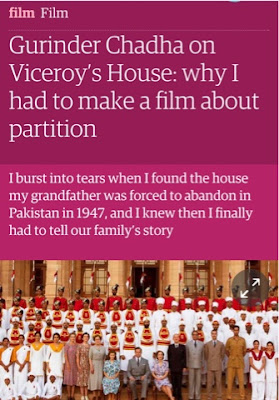
Really looking forward to 'Bend It Like Beckham' director Gurinder Chadha's next film, Viceroy's House, due out next year. It certainly has a cracking cast in Hugh Bonneville, Gillian Anderson, Simon Callow, Om Puri and Huma Qureshi :
https://www.theguardian.com/world/2016/apr/16/gurinder-chadha-on-viceroys-house-why-i-had-to-make-a-film-about-partition?CMP=share_btn_tw

Gurinder Chadha's films are always a treat especially to second-gen onwards Brit-Asians such as myself though they certainly have a wider appeal.  I also happen to hail from the director's same West London suburb and from a Sikh-Punjabi background so her material particularly resonates with me and it's always interesting to see what she's homing in on. Every Punjabi family has a partition story - I'm curious to see how she handles hers and how she mediates it within the grammar of film-making and the demands of commercial cinema.

In a more recent interview from this month, this time an event at America's Clark University, we learn that:

"Chadha is currently in the post-production phase of her film, “Viceroy’s House,” which will be released in 2017. The film chronicles the British partition of India and Pakistan, and the intertwining of many cultural perspectives during a controversial time in South Asian history. “I was very clear that this is a film made by a British Punjabi; it’s very much that perspective,” said Chadha. “No Indian could have made it, and no Pakistani could have made it, and no white British could have made it.”

“Viceroy’s House” tells Chadha’s family history. “When I was growing up I had come to understand that partition happened because it was our fault — that we Hindus, Sikhs, and Muslims couldn’t get on with each other,” Chadha recalled. “There was violence and the British had no option but to divide the country. … As a result I had somehow felt that the loss of a homeland was a result of my ancestors’ fault.” Chadha said that when archived historical documents eventually became public, she and her family learned the partition was a political act."

Read more from this event here.

Saturday, 23 April 2016

New Eltham's Fiddler on the Roof

Musical theatre is not normally my thing. The final straw came a couple of decades ago when I had to walk out of Lloyd Webber’s never-ending show, Time, at the interval – I couldn't stand it anymore.

All that suspension of disbelief, all those excruciating looks on their faces as they emoted around tenuous plots – no. No more. I was done.

It may be surprising to hear this from a Brit-Asian bought up on a diet of Bollywood's musical films. In these films it was an unremarkable and frequent happening for 30, or more, backing singers and dancers to suddenly pop up and accompany the hero and heroine as they burst into song in some verdant scene.

Admittedly, the more excessive fantasy sequences went out with the 80s and 90s (I’m thinking demure Indian woman, with improbably blonde wig, with oversize silver puffball sleeves, swinging on a huge low-slung crescent moon amidst a smoke machine on full power…you get the picture). No, these days one is able to enjoy more ‘realism’ in Bollywood cinema, though it’s all relative of course. I mean, the highly-westernised, elite wealthy, light-skinned lives portrayed in many of today’s Indian blockbusters are a million miles away from the lives of ordinary Indians.

I was amazed then to find myself transfixed by last night’s production of Fiddler On The Roof by New Eltham Community Productions (NECP), a performing arts groups based at the New Eltham Methodist Church in the south-East of London. What had initially been a well-meaning booking to support some local artistic activity has now turned out to be a revelation.

From the Programme
The stunning quality of all the creative talent on show belied the fact that this was an amateur production. The spot-on choreography, the surprise live orchestral music, the period costumes, the track lighting and, of course, the acting, would not be out of place at a central London venue at a ticket four times the price. Instead, we were sitting in a small church community centre in a sleepy suburb (or ‘New Eltham Village’ if you please…)

‘Fiddler’ is of course a well-established musical play and film, a staple for amateur companies – the story of a life in Anatevka, pre-revolutionary Russian Jewish village, focussing on Tevye’, a dairyman and the ‘Papa’ trying to bring his daughters up according to the long-held traditions of the community. Modernity and love get in the way, as ever. The setting may seem obscure but its universal themes, and stonking tunes, have proved highly-appealing. Come to think of it, this IS every Bollywood film!

This NECP production is skilfully directed and choreographed by Hannah Bond.  The large cast challenged with many musical numbers and dances were brilliantly handled. The catchy opening whole-cast number ‘Tradition’ set the tone and was a refrain throughout. Later “If I was a Rich Man” was subtly done without giving into to hamming it up. The key lead Jewish father, Tevye is played brilliantly by Neil Stevens who, by all accounts, grew a beard especially for this part along with other male cast members. He struck just the right note with his combination of serious and comedic acting (“On the one hand…, on the other hand…, on the other hand, there is no hand”). For me, a large part of this production’s success was Neil Stevens’ ability to hold the audience for his solo pieces and to take us so convincingly with him on his journey. The acting was matched by his stage wife, Golde, played magnificently by Rachel King, with both of them excellent singers too.


A real and unexpected treat was the live orchestra and the entrancing 'fiddler' who started off playing in a small balcony above the stage and then descended later to interact with Tevye as he muses on life.

There was poignancy, comedy and romance in the portrayal of this little village but also the intrusion of the darker outside world. We see this Jewish community in Russia subjected to a progrom by anti-Semitic Czarist forces forcing our characters to flee and scatter, many setting off to emigrate to America as refugees, a sadly familiar scenario still with us though with different collection of communities, faiths and countries.

In short, I’d thoroughly recommend this production though it finishes its run tonight! However, I’m so glad to add the discovery of this gem to our list of local Eltham and SE London venues. We shall be looking out for the next NECP production.

See local professional photographer Robert Piwko's fabulous photographs of this production here.

Tuesday, 25 January 2011

Lewisham cinema, BBC Radio 4 on film and a bit of Bollywood

Following my post the other day about South East London cinema, I was happy later to see this co-incidental post at Brockely Central about old cinemas in Lewisham. They've linked to the Brockley Film Club's fantastic digital recreation of the old cinemas of Lewisham, placing them in their modern day contexts - they've got recreations of:

- The Obelisk, 12 Loampit Vale. Opened in 1912, closed in 1923
- Gaumont Palace, 1-5 Loampit Vale. Opened in 1932, later renamed Odeon, closed in 1981 and demolished in 1991.
- Prince of Wales Cinema, 210 Lewisham High Road. Opened in 1922, closed in 1959 and later demolished
- King's Hall, 15 High Street. Opened in 1912, bomb-damaged during the second world war
- Rex Cinema, later renamed Studios 6/7, 15 Lewisham High Street. Opened in 1950, closed in 1986 and demolished in 1988.

What a lot of cinemas in that borough. I'm not surprised in a way because, in yet another bizarre co-incidence, I happened to be listening to a fascinating Radio 4 programme last week about early cinema and just how much a part of ordinary life was "going to the pictures" (it might have been this programme).  It turned out that BBC Radio 4 are at the moment having a season on the history and impact of cinema. You might still be able to catch some of the radio programmes in BBC iplayer.

If you can't be bothered with that, you can at least tune into this next Saturday:

"as the film season draws to a close, in a special Archive On 4, there's another chance to hear highlights from the Brief Encounters series in Brief Encounters: A World View Of Cinema. As well as an omnibus selection, listeners will hear from filmmakers and film experts who will be their guide to the global consumption of cinema (Saturday 29 January, 8pm)."

Sounds good to me.

And finally (as they say), a British-Asian writing about film and not mentioning Bollywood? Let me correct that - here's one of my early musings on 'Coming out about Bollywood'.

Sunday, 17 October 2010

BFI London Film Festival 2010

The BFI London Film Festival started last week, running to 28 October. What an absolute smorgasbord of film offered all over London. It's a feast and I just wish I had a week off to indulge myself. Here's some quick picks of films on India  /diaspora-related themes which will prove an antidote to Bollywood  -though there's plenty else on offer:

Dhobi Ghat 
This debut feature by Kiran Rao takes us into the multi-layered world of modern Mumbai, where its inhabitants, separated by class and culture, rarely interact in a deeper way. Successful, reclusive artist Arun (played by India's most popular actor, Aamir Khan) looks to find new inspiration, moving to an apartment... (image above from this film)

Pink Saris
 
Pink saris are worn by the Gulabi Gang, a group of women vigilantes in Northern India. From the untouchable caste, they resist being condescended to as the lowest social class. They have a champion in the form of the formidable Sampat Pal, who takes up their cases of social injustice...

Autumn
 
Gripping filmmaking, Aamir Bashir's tale throws you into the heart of the conflict in Indian Kashmir, often dramatised by Indian cinema but rarely shown from the perspective of the common man. Rafiq is a sensitive, young Kashmiri man haunted by the loss of his elder, photographer brother, who has disappeared...

Just Another Love Story
 
Acclaimed Bengali director Rituparno Ghosh moves in front of the camera to act in Kaushik Ganguly's film, which unashamedly shakes the foundations of contemporary Indian sexuality. Abhiroop (Ghosh) is an openly gay filmmaker from Delhi intrigued by the story of 70-plus Bengali performer Chapal Bhaduri, famous for playing roles as...

The Nine Muses
 
Sharing some thematic and aesthetic ground with his widely acclaimed gallery piece Mnemosyne, but developing and extending the focus, this new feature work confirms John Akomfrah as one of the UK's most singular and visionary filmmakers. In this work of uncommon intelligence, a vast array of archival material is combined...

The Good North

The people of a remote Yorkshire village come to terms with the recent beating of a young Asian lad (a 7min short)


Paan Singh Tomar
 
Leading character actor Irrfan Khan (BAFTA-winning The Warrior), breathes life into this action-packed biopic of Paan Singh Tomar - a real-life athlete who turned into a feared bandit king. Wild-eyed villager Paan Singh joins the army with dreams of serving his country, but his unpredictable nature doesn't sit well with...

The Indian Boundary Line

Comerford's essay maps a historical demarcation which originally divided Native American land from that which was ceded to white settlers in 1812. Modern life has obscured the traces of this history in the current Rogers Park district of Chicago. Juxtaposing past with present, footage shot along this formerly disputed territory...

Why Colonel Bunny Was Killed 

An exploration of turn-of-the-century colonial life along the Durand Line, the frontier between Afghanistan and British India (now Pakistan). Remarkable period photographs are closely analysed as we listen to reports of exchanges between westerners, natives and mullahs written by missionary doctor TL Pennell.

Udaan 
A Cannes selection in Un Certain Regard, this debut feature by Vikramaditya Motwane offers a new, cool image of middle-class India. Rohan and his 17-year-old fun-loving buddies get into trouble at public school for the last time, and are all expelled. Unlike his richer mates, Rohan must return to a...

Tuesday, 5 October 2010

Peepli [Live] - India's entry to the Oscars

A film purporting to be "Bollywood meets arthouse" and an "anti-Slumdog Millionaire" has recently been chosen as India's entry to the Academy Awards in the Best Foreign Language film category.

Peepli [Live] is a social satire with an unstarry cast yet it opened in August to rave reviews. The film is produced by well-known actor, and latterly producer, Aamir Khan and directed by Anusha Rizvi. It differs from the usual Bollywood fare because rather than romance and melodrama, it explores the topic of "farmer suicides" and the subsequent media and political response.
The Times of India summaries the plot:
"Enter Peepli, a small village in the hinterland where a farmer duo, Natha (Omkar Das Manikpuri) and Budhia (Raghuvir Yadav) are struggling to hold on to their land. Threatened by extreme poverty, they fall upon a novel plan. Natha decides to commit suicide to avail of the one lakh [rupees] compensation package doled out by the government. But before he can do that, the news spreads like wildfire.

The unknown hamlet soon becomes the favourite hunting ground for the voyeuristic news channels, hungry for TRPs, unscrupulous politicians, eyeing their vote banks, fumbling bureaucrats, foxed and clueless about the strange turn of events...Can the farmer's family hope for succour? Is India equipped to handle its swelling population of forgotten and marginalised citizenry? Does Natha survive? Good questions.... "
People have been raving about the film. It certainly sounds intriguing on many levels. A good counterbalance to the glitz, money and controversy around the current Commonwealth Games in Delhi. The film opened in the UK on 24 September. You can check here to see where it's showing.

Some reviews and the trailer (in English):

- Spiked article, by Felix Holmgren

Tuesday, 27 April 2010

Greenwich on film: The Cost of Love

A quick mention of a film reviewed over at Greenwich.co.uk:
"The Cost of Love (cert. 18) is a new feature film that was filmed almost exclusively in Greenwich and features a very local cast and crew. ... Greenwich based male prostitute Dale (Christopher Kelham) has all sorts of clients. Dale sees them all, from voyeuristic guys into school uniforms, to an older gentleman into scrubbing the bathroom floor for ‘Sir’ (stylish Greenwich guesthouse owner Robert Gray of ‘The Hotel Inspector’ fame).

Dale loves his job, proclaiming: “I like sex, and lots of it”, however you question this as sometimes he delves deep into his imagination, suggesting that he might not love his job so much after all. Aside from this he also has a normal life as best friend and confidante to Raj (Valmike Rampersad). Raj is confused about his up and coming marriage to ‘boring’ Veena (Mandeesh Gill), shown in some beautiful sun-drenched riverside scenes.

It is quite clear that perfectionist cinematographer Amarjeet Singh has spent hours working on this fine film to make it look the way it does." Read the rest...

The film was shown as part of the East End Film Festival at the Genesis Cinema and details of further screenings can be found here. The film sounds interesting for its locations, the Asian angle and the gay sub-cultures it features. What with the recent Eastenders storyline (the Syed, Preeya and Christian triangle) and the forthcoming Indian 'gay film' it seems that the taboo combination of being both Asian and gay is at least beginning to be tackled.

Tuesday, 6 April 2010

Asian Alchemy in London

I'm back. Lots to write about - might tell you about Centre Parcs another time - but for now....

Talking about the Indian sub-continent being en vogue at the moment, there is a cracking festival just starting at the South Bank Centre in London. In it's own words: "Alchemy explores the culture of India, its diaspora and its relationship to the UK today in over 30 events spanning dance, music, literature, debates, fashion and food. 

Over five packed days discover classical masters of the sub-continent alongside emerging British Asian talent; folk traditions alongside contemporary experimentation."

The line-up looks fantastic, there just so much here - you can check up the programme here.

In the meantime, here below are some goodies I've picked out - the free showing of Sholay looks fun (orginally pointed out to me by Plummy Mummy) and the Southall Story events sound interesting. I'd be interested to hear about what you thought about any of it:

Credit: Jonah RamballLevel 5 Function Room
India: Global Powerhouse?
Wednesday 7 April 2010
Is India the new America?


A.R. RahmanRoyal Festival Hall
Wednesday 7 April 2010
The London Philharmonic Orchestra performs the works of the celebrated Indian film composer AR Rahman.

Southall Storytellers
Yellow Room, Spirit Level
Tuesday 6 April 2010 - Sunday 11 April 2010
Visit stalls, watch performances and meet local storytellers reminisce about Southall.

Southall StorySpirit Level
Wednesday 7 April 2010 - Tuesday 11 May 2010
The Southall Story explores the recent history of a place that has come to be affectionately known as Little India, but for many it is much more than that.

A Golden Age
Sunley Pavilion
Thursday 8 April 2010
Tahmima Anam's novel 'A Golden Age' is our first book club choice of the new season, and is part of the Alchemy Festival.


H-DhamiQueen Elizabeth Hall
Thursday 8 April 2010
Hosted and curated by Nihal from BBC Radio 1 and BBC Asian Network, this event marks the first time three of the biggest names in UK Bhangra - H-Dhami, Jaz Dhami and Juggy D - perform together

NihalThe Clore Ballroom
Thursday 8 April 2010
BBC Radio 1 DJ, Nihal hosts his BBC Asian Network show live at Southbank Centre. Join a discussion on the ingredients that make up Indian culture today.


Gauri Sharma TripathiPurcell Room
Thursday 8 April 2010
Gauri Sharma Tripathi is a key exponent of the north Indian classical dance form of Kathak.


SamayQueen Elizabeth Hall
Friday 9 April 2010
This evening brings together innovators of Indian dance and music from two different perspectives.


MilunFoyer Bar - level 2
Friday 9 April 2010
By combining the notes found in the standard minor scale in Irish music with well-known ragas in Indian music, Milun conjure musical conversations that exchange traditional motifs

The Teak ProjectThe Front Room at QEH
Friday 9 April 2010
The Teak Project represents a collaboration between three of Britain's finest young improvisers.


Sonia SabriThe Clore Ballroom
Friday 9 April 2010
Hosted and performed by Sonia Sabri and featuring special guest Mavin Khoo this event explores the roots of Indian classical dance.


Alchemy Market - A Taste of IndiaSouthbank Centre Square
Friday 9 April 2010 - Sunday 11 April 2010
During the Alchemy Festival, Southbank Centre Square offers a variety of Indian foods and crafts for you to enjoy, including hot dishes and chai. Come and try the tastes and smells of India.


A Golden AgeBlue Room, Spirit Level
Saturday 10 April 2010
Set amidst the Bangladeshi War of Independence of 1971, 'A Golden Age' is a novel about a country and a family at war.


Aakash Odedra & Sanjukta Sinha/ Seeta Patel & Kamala Devam/ Hetain PatelPurcell Room
Saturday 10 April 2010
This evening brings together several British born-artists investigating their Indian cultural heritage, together with dancers who share this line of enquiry from America and India.

The Southall Story
Yellow Room, Spirit Level
Saturday 10 April 2010
Including performances by Kuljit Bhamra and Mohinder Kaur Bhamra.


Sufi ZenQueen Elizabeth Hall Roof (free)
Saturday 10 April 2010
Highlighting the contrasts between the spiritual stillness of Zen and all-encompassing motion of Sufism

Nathan 'Flutebox' LeeQueen Elizabeth Hall
Saturday 10 April 2010
One ticket buys you a brilliant mini festival line-up of the most innovative artists from UK and India, with live bands and film soundtrack performances, VJs, DJs, spoken word and comedy

The Clore Ballroom (free)
Sunday 11 April 2010
Modern democracies are increasingly concerned about young people disengaging from conventional politics. Youth culture in India is said to be driving a wedge between old and young.

SholayThe Clore Ballroom (free)
Sholay
Sunday 11 April 2010
Southbank Centre marks the close of the Alchemy Festival with a screening of the classic Bollywood film 'Sholay'.

The Grewal FamilyQueen Elizabeth Hall
Sunday 11 April 2010
Southbank Centre brings the stars of the popular Channel 4 series 'The Family' to the stage for the first time.

Saturday, 20 March 2010

An embarrassment of riches

You wait ages for a good British-Asian female writer/director to appear on the British cultural scene and then two come along at once.

Aswell as Bhatti's play Behud ('Beyond Belief') starting in London in April, Gurinder Chadha OBE's latest film, It’s a Wonderful Afterlife, also opens here in April. Of course the origin of the artmaker does not matter other than the fact that you're bound to get more diverse material - I mean which non-British Asian is going to be writing about abuse in Sikh gurdwaras or ghostly goings-on in a Hounslow-based family?
 
Chadha's latest film tells the story of a British-Asian mother (Shabana Azmi) whose obsession with marrying off her daughter (Goldy Notay) has hilarious results. As the potential suitors meet their sticky ends, policemen Mark Addy (The Full Monty) and Sendhil Ramamurthy (Heroes) are brought in to investigate. Other actors include Jimi Mistry, Sanjeev Bhaskar and Zoe Wanamaker.

So the film is a comedy with some ghostly and afterlife themes. I like the way that the film poster (above) apes the style of the huge Bollywood hoardings and yet the film title is clearly a play on Frank Capra's 1946 film It's a Wonderful Life - very fusion. Chadha, director of films such as ‘Bend It Like Beckham’, ‘Angus, Thongs and Perfect Snogging’ and ‘Bride and Prejudice’, has said that Wonderlife is a film "that in many ways takes me back to my warm intimate family values of Bend It Like Beckham. I shot in the same Indian-centric localities of London.” By that she's presumably referring to the areas around Hounslow, in the west London suburbs. Critics have said that the film delivers what is expected, with all the usual ingredients of a Chadha film - frankly, that sounds good to me.

If you'd like to attend, or watch online, a free event next week at which Gurinder Chadha will be speaking about her latest film, here are the details:

Date and Time:  Wednesday 24 March 201,  6pm-7.30pm
Location: Ian Gulland Lecture Theatre, Goldsmiths, University of London, New Cross, London SE14 7NW
Admission: Free, booking necessary (at z.arabadji[at]gold.ac.uk to book a place)
Event name: the annual Olive Till Memorial Debate, organised by the Department of Media and Communications.  The event will be live-streamed at the link here.

It's a Wonderful Afterlife opens in the UK on 21 April.

The London premiere takes place at the Odeon West End, Leicester Square, on April 12; a 'regional premiere' on April 14 in Birmingham at Vue Star City.

Friday, 19 March 2010

London celebrates LGBT film while Bollywood's comes out with it's first gay screen kiss

I was reading about the intruiging BFI Lesbian & Gay Film Festival (17 to 31 March) which kicks off in London this weekend. One of the interesting things I learnt was that the first use of the word 'homosexual' in a English-language feature film was in 'Victim' - a 1961 film starring Dirk Bogarde - there is going to be an 'illustrated account of the creation and reception of one of the most important gay films ever made' tomorrow, Saturday at midday at the BFI.

It was with some irony that I read about this festival because I had not long before learnt about the expected impending furore over an Indian cinema film which is supposed to show Bollywood's first ever gay screen kiss.

Sanjay Sharma, the director, has made Dunno Y ... Na Jaane Kyun (Don't Know Why) which depicts a gay relationship in Mumbai. The release of the film, which some see as India's Brokeback Mountain, is due in May.  Sharma expects censors to pass the film for release after the repeal last year in India of Section 377 of the Indian Penal Code, a law against homosexuality - a law first framed under British rule that bracketed homosexuality with bestiality and paedophilia as crimes “against nature”, punishable by up to ten years in prison.
The decriminalisation of homosexuality is awaiting final approval by the Supreme Court, which is expected to be given after the Government backed the move last year.  The film is being released in English with subtitles, something which may make it more likely to avoid censorship.

The fuss about the kiss is a bit of sensationalism because I think that the really significant aspect of the film is the depiction of a gay relationship in a serious and genuine way. Up until now it has been common for gay characters in Indian cinema to be buffoons and the butts of jokes, e.g. recently Dostana ('friendship') and that's one of the more supposedly 'enlightened' ones.

The promotional posters (here, above-right) are quite risky for an Indian audience especially as public hetrosexual physicality is barely accepted. Yet Sharma believes that Indian audiences are ready. Y'know he might be on to something. I've often found it difficult to explain to non-Asians the primacy of male bonding and friendships. For example it is common in the streets of India to see hetrosexual (yeah, as far as we know, and they profess) men walking around hand-in-hand. I believe this also happens in some middle-eastern countries too.

In Indian film, in terms of the 'morality hierachy', male devotion to each other sits almost at the top of the tree (alongside mother-son love). For example, you are a true (male) friend if you sacrifice your (female) love object for your (male) best friend, even if you know she loves you rather than him. There are a number of 'love triangle' film narratives along these lines. Some wag has found a brilliant clip of a 1964 Indian film which supposedly shows Bollywood's 'real first gay kiss' (though not really because they are long-lost brothers) - just watch this - the kitchness of it all will make you cry....Rajendra Kumar and Dharmendra getting a little too emotional in Ayee Milan ki Bela.
 
So, enjoy the BFI festival and I hope that Dunno Y ... Na Jaane Kyun (Don't Know Why) passes the censors and has a sucessful run from May.

Wednesday, 3 March 2010

Tongues of Fire: London Asian Film Festival, March 2010

The 12th London Asian Film Festival starts this Friday, 5 March running through to 14 March. Known as the 'Tongues on Fire' festival, it aims to highlight indepdendent Asian cinema and has a focus on women. As I wrote last year, the festival manages to put together a great collection of films and guests around London and yet it is strangely under-advertised.

The festival has a great balance this year between 'Bollywood' (going big on the Bachchan family), middle-art cinema in Shyam Bengal, and some British-Asian cinema ('Life Goes On', 'Cash and Curry'). Here's just a taste of what's on:

Friday 5 March - BAFTA - "A BAFTA INTERVIEW" with ABHISHEK BACHCHAN
18:15 Reception
18:45 interview

Saturday 6 March - ACTING MASTERCLASS
11:30 Masterclass with Abhishek Bachchan
14:00 Guru screening  (at Apollo, Piccadilly Circus)

Sunday 7 March - CELEBRATING SPORTS THROUGH FILMS
13:00 Reception
14:00 Chak de India screening (at Rich Mix, London E1)

BAFTA - "A BAFTA INTERVIEW" with SHYAM BENEGAL
18:00 Reception
18:30 Interview
20:30 Well Done Abba screening
(Exclusive to TOF and BAFTA members - how annoying....)

Monday 8 March - DIRECTOR'S WORKSHOP
10:30 Bhumika screening
14:00 Workshop with Shyam Benegal (at University of Westminster)

INTERNATIONAL WOMEN'S DAY
14:30 Kora Kagaz screening
16:45 Q&A with Jaya Bachchan
17:45 'High-Tea in the presence of Jaya Bachchan' (sic)
18:30 Shyam Benegal Talk - Women in Films (all at the Nehru Centre, London W1)

Tuesday 9 March - JAYA BACHCHAN'S RETROSPECTIVE
18:30 Guddi  (at the Nehru Centre, London W1)

Wednesday 10 March
18:30 Abhimaan  (at the Nehru Centre, London W1)

Saturday 13 March
SCREENINGS
14:00 Cash and Curry (just got to see this...)
20:45 Lovesongs + Introduction by director (both at Watermans Cinema)

Sunday 14 March
CLOSING GALA PREMIERE16:00 Life Goes On - Premiere
18:00 Q&A and Reception with stars + director (at Apollo, Piccadilly Circus)

See the Festival website for more details, other events.which are part of this festival and for details about how to book. Let me know what you thought if you go to see anything here.

Monday, 18 January 2010

Land Gold Women: a film about 'honour' killing

News has been bubbling about a debut film by a young female director which is set in Birmingham, UK. Land Gold Women is about a so-called 'honour' killing in a British-Asian setting.

Writer and director Avantika Hari, still only in her twenties, wanted to make a film which explored exactly why a relative would murder one of their own female relatives. But this is not a film about an uneducated and unassimilated family - the father concerned is a university professor. The film has been doing the festival circuit - in December 2009 it won the Foreign Correspondent Association’s Purple Orchid Award for ‘Best Film’ and ‘Best Script/Screenplay’ at the Asian Festival of First Films in Singapore. (picture above courtesy Rewired PR)

Although produced by Bollywood's Vivek Agrawal, it's a small budget 'indie' film, in English and Urdu, shot in and around Birmingham. Writer/Director Avantika Hari worked closely with the Ashram Housing Association, an organisation which deals many cases of forced marriage every year. The cast are mostly British-Asian actors with Narinder Samra in the lead female role - you can hear her and others interviewed in this BBC clip. (Samra and the male lead in picture below).

The Land Gold and Women in the film's title refer to the elements in which 'honour' or 'izzat' are typically invested in such patriachal societies where these horrible events occur. It sounds to me like an especially timely film given the verdict last month on the horrifying case of the murder of Tulay Goren, a young Kurdish woman in the UK murdered by her own father for falling love with the wrong type of man as far as the family's men were concerned - the BBC reports on the case here.

Although such murders are thankfully rare, most women from such societies, including let's be honest many British-Asian women will know all about how their behaviour, dress and views are seen as reflecting on their family, to whatever degree. It's an element of Indian society that frankly used to cause me a lot of frustration - I felt it clipped the wings of so many young women while their brothers roamed free. So the film should be interesting...

Unfortunately I haven't heard about a UK distribution - the film had its (presumably one-off) UK premiere in February 2009 at Cineworld in Birmingham. More information here.

Monday, 4 January 2010

Indian Winter on Channel 4

I was interested to see that Channel 4 are having an 'Indian Winter' season. A mix of film, documentary and features, it begins with a TV premiere showing of the film Slumdog Millionnaire (on 13 January, 9pm), Danny Boyle's Oscar-winning blockbuster. How on earth it was billed as a 'feel-good' film at the time of its original cinema release I'll never know - I could hardly stop blubbing for the first 40 minutes or so.

The season also includes Gordon Ramsey and Kevin McCloud in their own programmes from India, as well as some Bollywood big-hitting films such as Rang De Basanti (14 January, 01.15), Jodha Akhbar (18 January, 00.15), and Om Shanti Om. Typically though, the screening times continue to assume that Bollywood fans are also insomniacs.

Nice though it is, I'm not sure why Channel 4 have chosen to focus on India and in a 'winter season' (anyone see this explained anywhere?) other than tryng to cram in as many 'slumdog' references as possible in their programme titles e.g. Slumdog Secret Millionaire, Slumdog Children of Mumbai and Slumming It all feature in this season.

Tuesday, 3 March 2009

Tongues on Fire Asian Film Festival, 6th - 15th March 2009, London

This great festival starts soon. It is "dedicated to expressing the drive and spirit of Asian independent media and cinema cultures of South Asia". See the events calendar and website here.

Highlights include the UK premiere of Deepa Mehta's HEAVEN ON EARTH, with special guest DEEPA MEHTA on 6th and 7th March 2009. This film leads the big gala opening - in it "Preity Zinta plays the leading role of Chand, a young Indian Punjabi woman who finds herself in an abusive arranged marriage with an Indo-Canadian man".

Tickets are sold out for the 6 March showing with the Q&A, but Heaven on Earth will be screened again on 9th March at Watermans, you can book through them directly. I'm told there are still tickets available for Saturday, 7th March, Life in Pictures, with Deepa Mehta, which will be a tribute to her works and Deepa will be there in conversation -this is £40/pp includes a champagne reception (blimey!)

Another highlight is In conversation with Gurinder Chadha on Fri 13 March, at Courthouse Kempinski, 19.00 for a reception, 20.00 for the conversation.

This strangely under-advertised festival is a gem - there is no similarly 'niched' event on this scale in the UK, so get along to it if you can, and let me know what you thought.

Monday, 2 March 2009

Coming out about Bollywood

Why would any sane, thinking, educated person be attracted to 'Bollywood'? Well, this is a loaded question - it encodes all sorts of assumptions about this genre and neglects to appreciate its multi-layered offerings (which are even more multi- if you are a Brit-Asian). Frankly, it's a bit akin to the 'Big Brother' bashers - I mean, if you're interested in people, social relations, personal and identity politics intersected with media behavior, programme editing and 'celebrity', then surely BB is a dream!

I have always been intrigued by popular Indian cinema (or 'Bollywood', the western-friendly name to have emerged over the last 15 years or so). When I was a child it was the art form (the only one as far I can remember) which enthralled my mother's generation and class in the UK. In between double-shifts at factories, canteens and plants, these Indian immigrants in the late 1960s/early 1970s would eagerly dress up (beehives, mascara, pale lipstick and saris) and head off to the local cinema which some Indian entrepreneur had rented for the big Saturday night. For us this meant going to 'the Dominion' in Southall, West London in the UK, a town which had a concentration of Indians and particularly of Punjabi Indians.

My brother had I only had then a basic, developing, knowledge of Punjabi but still we managed (mostly) to follow the Hindi dialogue of films such as Andaz, Hare Rama Hare Krishna, Bobby, Pakeezah, and Sholay, classics for which any Indian will be able to reel of a fair amount of dialogue They were magical but strange nights. Stepping out of our English, weekday selves, my brother and I entered a world which was completely alien to our assimilated personas at school. So that's one relationship I have with Indian cinema.

Later, in the age of affordable domestic video players, cinema-going diminished amongst Brit-Asians in the late 1970s though viewing films remained popular. In my teens now I was more interested in creating some space between my tastes and that of my parents' generation. Trouble is, there was very little British-Asian 'youth culture' about (But that's the subject of another blog...).

Skip to the present, and Bollywood is my connection with my 'imagined community', as I now live in a pretty much non-Brit Asian world. Apart from the usual fare, I particularly enjoy the relatively more 'left-field' stuff especially films which have something to say about society and politics; films such as Hazaaron Khwaishein Aisi ('A thousand dreams like this') (Dir. Sudhir Mishra, 2005) - this film follows its three protaganists in the 1970s against the backdrop of the Indian Emergency, and India's massive social and political changes, including the Naxalite movement in South Bengal. A gratuitous picture of Shiney Ahuja here, one of the film actors - another good reason for watching this film (ahem...).

If you want to know more about popular Indian cinema you could do a lot worse than to read Mihir Bose's Bollywood: A History (2007). Despite it's cover (blimey!), it's actually a very comprehensive and readable gallop through Indian cinema, right from the first shaky and silent black-and-whites right up to the early 2000s.

So that's the explanation of my 'guilty pleasure', though I think some of the films are crossing over into 'world cinema' and would easily be the subject of a 'western' film buff 's trip down to the BFI. But I make no excuses (well, just a few...) and need no endorsement, honest. I'd like to hear some of your recommendations from Indian cinema. And I may from time to time tell you about what I've been watching. So, kaan khol ke sunlo.... ('open your ears and listen' - a much-used formulaic line from Bollywood).